NameSilo

What's going on with Epik and Rob Monster?

SpaceshipSpaceship
Watch

MapleDots

Account Closed (Requested)
Impact
13,186
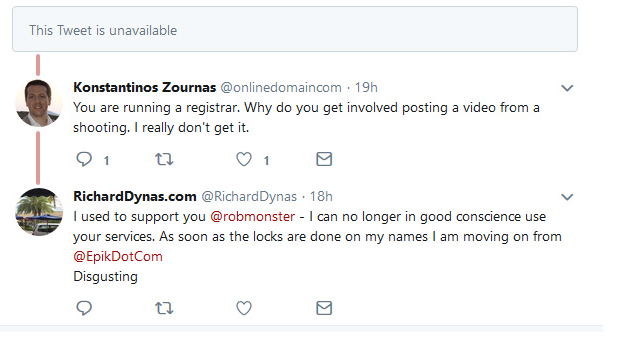
I'm catching the tail end of this, seems to be some kind of controversy...

https://domaingang.com/domain-news/rob-monster-off-twitter-after-christchurch-massacre-controversy/

Must be something odd to evoke this type of a response from one of our members.

Picture0016.png
 
9
•••
The views expressed on this page by users and staff are their own, not those of NamePros.
Unstoppable Domains โ€” AI StorefrontUnstoppable Domains โ€” AI Storefront
There isn't a subject that I can think of that I personally could not or would not be open to discussing so long as there was an agreed upon decorum.

No matter the position, proper use of vocabulary and respectful exchange of ideas, make understanding possible. Understanding makes workable solutions possible. Workable solutions only need a plan to achieve success.
 
3
•••
@Dotword,

A web host has a much more direct connection to content than a registrar does. After all, they store and disseminate the actual files of the website. Regulators and the general public often confuse registrars with hosts. You'd be surprised how often Epik or any other registrar is asked to share the source files of some website that is hosted by a separate company. (Gab.com is an example of this.)

I often have to explain to attorneys or bureaucrats that a domain registrar โ€“ insofar as it is just acting as a registrar โ€“ basically has no involvement with any website at all. Registrars keep a record of whois contact information for the name itself. Registrars collect payments and process renewals, transfers, etc. They provide an interface for defining the name servers, which indicate which company controls the DNS records. And that may or may not be the registrar. If there is a website or email, then that is manged by the web host not the registrar. (Most registrars offer hosting, but many registrar customers host with a separate company.)

Basically, registrars allow the public to own domain names โ€“ nothing more. Policies for who can register what names and also how the domains must or must not be used are defined by TLD registries. And policies for domain ownership and processes generally are defined by ICANN (for gTLDs) or by ccTLD registries.

After this long preamble, what am I getting at? This:
  • Registrars have no access to content and no way to inspect content beyond what the general public has.
  • Registrars have no control of content. Files are stored by the web host, which has control and access.
Registrars can only take action with respect to content in the crudest way possible: By yanking the plug. Whether that means confiscating a domain, suspending a domain, deleting a domain, or diverting the name servers, the end result is the same binary choice. The only options available to a registrar are:

(A) leave the cord plugged in (domain name still maps to web host);
(B) disconnect the cord (domain name cannot reach web host).

Yes, a registrar can use this OFF/ON power as an ultimatum, coercing a registrant to change the content they are hosting with a separate company. But is this the ideal way to for online content to be adjusted or policed?

Consider that many registrars are small companies. That means the person who is evaluating the content and deciding whether to unplug the metaphorical TV that someone else is watching is acting in a part-time capacity to police content, often in a rush, generally with no clear policy and zero training, and absolutely no relevant experience in determining what is or isn't legal. Do we want that person censoring the web?

It's also true that many registrars are spineless and will cave instantly to pressure. Some will say this is a good thing because they're envisioning public outrage over extremely offensive or dangerous content. But outraged crowds aren't always right. And the pressure isn't always coming from a crowd of representative normal people. Sometimes it comes from lobbyists. For example, there are certain groups that represent the interests of pharmaceutical trademarks. They bully registrars into suspending or deleting domains without due process for the registrant. And many registrars comply. Registrars that direct these lobbyists to the UDRP (which is what ICANN created to deal with TM disputes) are defamed in public as "bad actors" or "rogue registrars". Do we want registrars to pull the plug on websites โ€“ when, remember, the registrar isn't providing the website at all โ€“ just because someone threatens to say negative things about the registrar? Shouldn't there be a process to protect the registrant? Shouldn't someone independent make the judgment call?

It's crucial to understand that a registrar is an outsider looking at whatever content is publicly visible. Some other company hosts that content. Some other person created that content. A registrar may not have enough access to the content to see whether abuse has occurred or even what the content really is or was. For example, the content may exist behind a login. Or the content may have been interrupted by the web host or deleted by the webmaster. Often in abuse cases, a registrar is asked to evaluate content it can't even see โ€“ relying entirely on a complainant's description of the content.

Elsewhere, I described a case involving a website that endorsed rape. Epik deleted the domain right away. But we were never able to see ANY of the alleged content. Anyone seriously interested in how a registrar polices content can read my summary of that case:

https://www.namepros.com/threads/so...er-or-suspension.1107245/page-24#post-7170517

Web hosts have more access to and control over web content than anybody else except the webmaster. So it is logical to focus on web hosts when evaluating content, even if web hosts don't necessarily have the relevant expertise or authority for judging that content's legality.

Also, a web host has the ability to manipulate a website or email account in a more selective or surgical way. They can remove a single offending page without taking the whole website down. They can temporarily block a specific email address from sending without blocking other addresses from sending or annihilating all inboxes. Thus a web host is the most relevant partner for investigating abuse AND enforcing abuse. Yet that still doesn't mean the web host is qualified to judge abuse. They may do so, based on their own policies. But nothing guarantees that they will do so competently or fairly.

Let me add that a registrar and web host are not the only players in the domain supply chain that have this ON/OFF power to pull the plug on a website or email.
  1. ICANN itself is completely neutral, refusing to police domain usage directly. ICANN thereby fosters online free speech.
  2. UDRP forums, designated by ICANN, will adjudicate trademark disputes involving domains, . Unlike some arbitrary registrar employee, the panelists are experts who can devote their full attention to the evidence and (ideally) make an impartial decision. Though there are abuses that need reform, the UDRP does help eliminate trademark infringement, phishing, and other abuses.
  3. TLD registries and back-end operators can suspend any domain, without relying on any information or action from the registrar. They can do this because they are upstream of the registrar in the supply chain. The registry's cable connects to the registrar's cable, which plugs into the host. So the registry can unplug entirely on their own.
Registries suspend domains on their own all the time. ccTLD registries do this. Often they do it because of residency requirements in the country in question. But at Epik, I've also seen ccTLDs enforce their own policies about trademarks or abuse or whois formatting without any adjudication at all. And this has occurred in response to pressure from complainants.

gTLDs and sTLDs often have special policies about who can register domains. So it's not uncommon for them to suspend domains based on the registrant's lack of qualifications, lack of response, or lack of demonstrated usage in the relevant field. Beyond that, some of these registries also have policies about abuse such as phishing and malware distribution. And a few of them police these problems actively, causing domains to be suspended in the background in bulk. Registrars get periodic summaries of domains that the registry has chosen to suspend or delete. In some cases, neither the registrar nor the registrant gets any notification; and we piece together the facts about a secret registry suspension only when the registrant asks, "Where did my domain / website go?"

It has always struck me as strange that โ€“ in the Gab.com scandal โ€“ people focused entirely on the registrars, GoDaddy and Epik. Nobody that I'm aware of mentioned Verisign. I gather that Verisign stayed out of the question of whether Gab.com should be suspended or censored. In doing so, Verisign took a stance of complete neutrality or agnosticism, which is basically supportive of free speech.

Yet nobody attacked Verisign for not pulling the plug on Gab.com. Their ability to review Gab's content is exactly the same as a domain registrar's ability to review Gab's content. Both would need to assign someone to spend time reading Gab member's posts. Also, Verisign's ability to pull the plug on the domain registration is basically just like a registrar's ability to do so. Either at the registry level or at the registrar level, the connection to the web host could be severed. But the important difference is that a registry decision would be absolutely conclusive. When a registry suspends a domain, no registrar can offer it.

The general public has no understanding of what a TLD registry is. Because registrars interact with customers, and GoDaddy runs Super Bowl commercials, the general public became fixated on the registrar as the entity that MUST pull the plug on the racist TV that the racists were watching. But anybody with an ounce of experience knows that a domain that is suspended at 1 registrar will simply be transferred to another registrar.

It surprises me that the domain industry went along with this view that the registrar is primarily responsible for policing and censoring content. Domainers should know that a web host is more directly involved in content than a registrar is. Furthermore, domainers should recognize that Verisign could have suspended Gab.com totally.

Who has the responsibility to police content? I've written earlier that I think responsibility should fall (whenever possible) on the stakeholders in the content: the site owner, the managers, the board of directors, the webmaster, the moderators, the writers or editors, the forum members, etc. At the same time, monitoring for illegal activity is mostly crowdsourced. Just like law enforcement agencies, registrars, registries, and web hosts rely on someone to report abuse. The questions then become:
  • Who is competent to review the content?
  • Who can adjudicate impartially?
  • Who has authority, based on TOS or the law, to take action?
  • What action should be taken?
In some cases, a registrar or a web host can make a quick judgment call on abuse and take action themselves. Examples include phishing, spam, malware distribution, child pornography. Provided there is sufficient evidence to see what is going on, with egregious cases in those areas, nobody needs to wait for a court order to decide if such things are legal.

But policing individual posts by individual members in a forum that has its own staff? Is that a registrar's role? Should Dynadot be policing NamePros posts and delivering an ultimatum based on its crude ON/OFF power to pull the plug on NamePros.com entirely? Few of you would say yes. The position of Epik, as a domain registrar, to a website like Gab.com is precisely the same as Dynadot's obligation with respect to NamePros.


#1
I'm not a lawyer. When Epik receives abuse allegations, we investigate the evidence. Usually the nature of the abuse gives us a clear sense of the action Epik would take against the domain / customer. Since we would be taking action to stop the abuse, that's that. When in doubt about our responsibility to act, we investigate the legal requirements. It's impossible to give a general answer because the range of possible abuse (and the particular circumstances) is quite large.

But it's important to emphasize that registrars don't actively monitor or police web content. That isn't our role. And it would be infeasible, practically speaking. The ratio of domains to employees at a registrar would be something like 50,000 or 100,000. How is a registrar employee (who already has a full time job) supposed to monitor the online content for so many domains? The content might change day to day. Or it might be quite vast โ€“ as is the case with an online forum or a news site. Some content might be hidden behind logins or exchanged invisibly as email messages sent to others.

Actively monitoring online content would thus be impossible for a registrar or even a web host. Our responsibility to police usage depends, first and foremost, on allegations made by some external party. ICANN requires that registrars maintain a designated contact for reporting abuse. ICANN obligates all registrars to display that contact in particular ways and to respond. Aside from ICANN's requirements, each registrar exists asa corporation in its own jurisdiction, which has its own requirements. And overseas jurisdictions sometimes assert their own regulatory claims. The worldwide web has worldwide complications.

#2
You can read the case study I mentioned above to see how Epik policed domain usage in 1 case.

#3
I have no idea if Gab or any other website on the web contains illegal content. It has never been my role nor my hobby to go looking. In my whole life, I think I looked at the Gab.com website only once. What I happened to see there disgusted me, and I was not inspired to keep coming back.

If a law enforcement agency believes there is illegal content on a website, they can contact any domain registrar to indicate the action or information they would need. Registrars comply with such requests. Indeed, Epik received a subpoena related to Gab almost immediately after the domain transferred to Epik. As usual, the subpoena seemed to imagine that Epik was the web host. Since we were not, there was little information to give. But we gave it. I assume they sent a similar subpoena to GoDaddy, which had been the registrar for a much longer period, and to the web host. That was last Fall, and I've heard nothing since.

A registrar complies with official determinations. When a UDRP is filed, we supply the UDRP forum with unmasked whois contact details and other domain information, as required by ICANN. We also apply a mandatory lock on the domain that prevents whois updates or transfer. And once the UDRP case is decided in the complainant's favor, the domain is delivered to the complainant or (less commonly) deleted. That depends on their preference.

UDRP cases are only disputes about trademarks. They're generally not as gravely serious as phishing or child pornography or spam or any other kind of abuse or illegal activity. Since a registrar like Epik complies fully with a UDRP complaint, divulging information and ultimately reassigning the domain according to the received decision, you can imagine that Epik would comply every bit as much with investigators into more serious questions of illegality.

What is legal or not has always been a question for legislators (who write the laws), police (who enforce the laws), and courts (who adjudicate the laws). Let's not forget that. Registrars, like all other companies, comply with those laws. But registrars don't have any special responsibility โ€“ let alone expertise or authority โ€“ to decide what is legal. Registrars could act as judge / jury / executioner, and allow some part-time employee without training or full access to content to pull the plug on websites and email accounts. But should we expect registrars to do that?

Wouldn't the web be more reliable and more fair if registrars endeavored to remain as neutral as Verisign did or as ICANN did? Laws are still enforceable. Those neutral parties cooperate. But that doesn't mean they should be a substitute for legislators, police, and courts.[/USER]


let me see if I understand you rightly:

The domain registrar has no influence on the content of a domains web space.

I think I got it.

But do I remember right
there was some kind of irritating post
on a web space that was on a domain that you do not control contentwise?

how come that content was there???
 
0
•••
@Slanted

In summary:

1. No mandatory policing required at any level (forum, web host, registrar, registry).
2. Investigations are triggered by complaints.
3. Left to the end user to report violations (up the chain or to law enforcers).​

I realise this is an industry-wide picture but it is disappointing. Relying on users of sites to report content suspected of being unlawful. Not even any random checks etc. Btw it is easy to make the mistake that Epik also provides web hosting for GAB but in fact and as you know Cloudflare does.
 
0
•••
@Slanted

In summary:

1. No mandatory policing required at any level (forum, web host, registrar, registry).
2. Investigations are triggered by complaints.
3. Left to the end user to report violations (up the chain or to law enforcers).​

I realise this is an industry-wide picture but it is disappointing. Relying on users of sites to report content suspected of being unlawful. Not even any random checks etc. Btw it is easy to make the mistake that Epik also provides web hosting for GAB but in fact and as you know Cloudflare does.

cloudflare doesn't host webpages to my knowledge
just serves the name servers
 
0
•••
@Dotword,

A web host has a much more direct connection to content than a registrar does. After all, they store and disseminate the actual files of the website. Regulators and the general public often confuse registrars with hosts. You'd be surprised how often Epik or any other registrar is asked to share the source files of some website that is hosted by a separate company. (Gab.com is an example of this.)

I often have to explain to attorneys or bureaucrats that a domain registrar โ€“ insofar as it is just acting as a registrar โ€“ basically has no involvement with any website at all. Registrars keep a record of whois contact information for the name itself. Registrars collect payments and process renewals, transfers, etc. They provide an interface for defining the name servers, which indicate which company controls the DNS records. And that may or may not be the registrar. If there is a website or email, then that is manged by the web host not the registrar. (Most registrars offer hosting, but many registrar customers host with a separate company.)

Basically, registrars allow the public to own domain names โ€“ nothing more. Policies for who can register what names and also how the domains must or must not be used are defined by TLD registries. And policies for domain ownership and processes generally are defined by ICANN (for gTLDs) or by ccTLD registries.

After this long preamble, what am I getting at? This:
  • Registrars have no access to content and no way to inspect content beyond what the general public has.
  • Registrars have no control of content. Files are stored by the web host, which has control and access.
Registrars can only take action with respect to content in the crudest way possible: By yanking the plug. Whether that means confiscating a domain, suspending a domain, deleting a domain, or diverting the name servers, the end result is the same binary choice. The only options available to a registrar are:

(A) leave the cord plugged in (domain name still maps to web host);
(B) disconnect the cord (domain name cannot reach web host).

Yes, a registrar can use this OFF/ON power as an ultimatum, coercing a registrant to change the content they are hosting with a separate company. But is this the ideal way to for online content to be adjusted or policed?

Consider that many registrars are small companies. That means the person who is evaluating the content and deciding whether to unplug the metaphorical TV that someone else is watching is acting in a part-time capacity to police content, often in a rush, generally with no clear policy and zero training, and absolutely no relevant experience in determining what is or isn't legal. Do we want that person censoring the web?

It's also true that many registrars are spineless and will cave instantly to pressure. Some will say this is a good thing because they're envisioning public outrage over extremely offensive or dangerous content. But outraged crowds aren't always right. And the pressure isn't always coming from a crowd of representative normal people. Sometimes it comes from lobbyists. For example, there are certain groups that represent the interests of pharmaceutical trademarks. They bully registrars into suspending or deleting domains without due process for the registrant. And many registrars comply. Registrars that direct these lobbyists to the UDRP (which is what ICANN created to deal with TM disputes) are defamed in public as "bad actors" or "rogue registrars". Do we want registrars to pull the plug on websites โ€“ when, remember, the registrar isn't providing the website at all โ€“ just because someone threatens to say negative things about the registrar? Shouldn't there be a process to protect the registrant? Shouldn't someone independent make the judgment call?

It's crucial to understand that a registrar is an outsider looking at whatever content is publicly visible. Some other company hosts that content. Some other person created that content. A registrar may not have enough access to the content to see whether abuse has occurred or even what the content really is or was. For example, the content may exist behind a login. Or the content may have been interrupted by the web host or deleted by the webmaster. Often in abuse cases, a registrar is asked to evaluate content it can't even see โ€“ relying entirely on a complainant's description of the content.

Elsewhere, I described a case involving a website that endorsed rape. Epik deleted the domain right away. But we were never able to see ANY of the alleged content. Anyone seriously interested in how a registrar polices content can read my summary of that case:

https://www.namepros.com/threads/so...er-or-suspension.1107245/page-24#post-7170517

Web hosts have more access to and control over web content than anybody else except the webmaster. So it is logical to focus on web hosts when evaluating content, even if web hosts don't necessarily have the relevant expertise or authority for judging that content's legality.

Also, a web host has the ability to manipulate a website or email account in a more selective or surgical way. They can remove a single offending page without taking the whole website down. They can temporarily block a specific email address from sending without blocking other addresses from sending or annihilating all inboxes. Thus a web host is the most relevant partner for investigating abuse AND enforcing abuse. Yet that still doesn't mean the web host is qualified to judge abuse. They may do so, based on their own policies. But nothing guarantees that they will do so competently or fairly.

Let me add that a registrar and web host are not the only players in the domain supply chain that have this ON/OFF power to pull the plug on a website or email.
  1. ICANN itself is completely neutral, refusing to police domain usage directly. ICANN thereby fosters online free speech.
  2. UDRP forums, designated by ICANN, will adjudicate trademark disputes involving domains, . Unlike some arbitrary registrar employee, the panelists are experts who can devote their full attention to the evidence and (ideally) make an impartial decision. Though there are abuses that need reform, the UDRP does help eliminate trademark infringement, phishing, and other abuses.
  3. TLD registries and back-end operators can suspend any domain, without relying on any information or action from the registrar. They can do this because they are upstream of the registrar in the supply chain. The registry's cable connects to the registrar's cable, which plugs into the host. So the registry can unplug entirely on their own.
Registries suspend domains on their own all the time. ccTLD registries do this. Often they do it because of residency requirements in the country in question. But at Epik, I've also seen ccTLDs enforce their own policies about trademarks or abuse or whois formatting without any adjudication at all. And this has occurred in response to pressure from complainants.

gTLDs and sTLDs often have special policies about who can register domains. So it's not uncommon for them to suspend domains based on the registrant's lack of qualifications, lack of response, or lack of demonstrated usage in the relevant field. Beyond that, some of these registries also have policies about abuse such as phishing and malware distribution. And a few of them police these problems actively, causing domains to be suspended in the background in bulk. Registrars get periodic summaries of domains that the registry has chosen to suspend or delete. In some cases, neither the registrar nor the registrant gets any notification; and we piece together the facts about a secret registry suspension only when the registrant asks, "Where did my domain / website go?"

It has always struck me as strange that โ€“ in the Gab.com scandal โ€“ people focused entirely on the registrars, GoDaddy and Epik. Nobody that I'm aware of mentioned Verisign. I gather that Verisign stayed out of the question of whether Gab.com should be suspended or censored. In doing so, Verisign took a stance of complete neutrality or agnosticism, which is basically supportive of free speech.

Yet nobody attacked Verisign for not pulling the plug on Gab.com. Their ability to review Gab's content is exactly the same as a domain registrar's ability to review Gab's content. Both would need to assign someone to spend time reading Gab member's posts. Also, Verisign's ability to pull the plug on the domain registration is basically just like a registrar's ability to do so. Either at the registry level or at the registrar level, the connection to the web host could be severed. But the important difference is that a registry decision would be absolutely conclusive. When a registry suspends a domain, no registrar can offer it.

The general public has no understanding of what a TLD registry is. Because registrars interact with customers, and GoDaddy runs Super Bowl commercials, the general public became fixated on the registrar as the entity that MUST pull the plug on the racist TV that the racists were watching. But anybody with an ounce of experience knows that a domain that is suspended at 1 registrar will simply be transferred to another registrar.

It surprises me that the domain industry went along with this view that the registrar is primarily responsible for policing and censoring content. Domainers should know that a web host is more directly involved in content than a registrar is. Furthermore, domainers should recognize that Verisign could have suspended Gab.com totally.

Who has the responsibility to police content? I've written earlier that I think responsibility should fall (whenever possible) on the stakeholders in the content: the site owner, the managers, the board of directors, the webmaster, the moderators, the writers or editors, the forum members, etc. At the same time, monitoring for illegal activity is mostly crowdsourced. Just like law enforcement agencies, registrars, registries, and web hosts rely on someone to report abuse. The questions then become:
  • Who is competent to review the content?
  • Who can adjudicate impartially?
  • Who has authority, based on TOS or the law, to take action?
  • What action should be taken?
In some cases, a registrar or a web host can make a quick judgment call on abuse and take action themselves. Examples include phishing, spam, malware distribution, child pornography. Provided there is sufficient evidence to see what is going on, with egregious cases in those areas, nobody needs to wait for a court order to decide if such things are legal.

But policing individual posts by individual members in a forum that has its own staff? Is that a registrar's role? Should Dynadot be policing NamePros posts and delivering an ultimatum based on its crude ON/OFF power to pull the plug on NamePros.com entirely? Few of you would say yes. The position of Epik, as a domain registrar, to a website like Gab.com is precisely the same as Dynadot's obligation with respect to NamePros.


#1
I'm not a lawyer. When Epik receives abuse allegations, we investigate the evidence. Usually the nature of the abuse gives us a clear sense of the action Epik would take against the domain / customer. Since we would be taking action to stop the abuse, that's that. When in doubt about our responsibility to act, we investigate the legal requirements. It's impossible to give a general answer because the range of possible abuse (and the particular circumstances) is quite large.

But it's important to emphasize that registrars don't actively monitor or police web content. That isn't our role. And it would be infeasible, practically speaking. The ratio of domains to employees at a registrar would be something like 50,000 or 100,000. How is a registrar employee (who already has a full time job) supposed to monitor the online content for so many domains? The content might change day to day. Or it might be quite vast โ€“ as is the case with an online forum or a news site. Some content might be hidden behind logins or exchanged invisibly as email messages sent to others.

Actively monitoring online content would thus be impossible for a registrar or even a web host. Our responsibility to police usage depends, first and foremost, on allegations made by some external party. ICANN requires that registrars maintain a designated contact for reporting abuse. ICANN obligates all registrars to display that contact in particular ways and to respond. Aside from ICANN's requirements, each registrar exists asa corporation in its own jurisdiction, which has its own requirements. And overseas jurisdictions sometimes assert their own regulatory claims. The worldwide web has worldwide complications.

#2
You can read the case study I mentioned above to see how Epik policed domain usage in 1 case.

#3
I have no idea if Gab or any other website on the web contains illegal content. It has never been my role nor my hobby to go looking. In my whole life, I think I looked at the Gab.com website only once. What I happened to see there disgusted me, and I was not inspired to keep coming back.

If a law enforcement agency believes there is illegal content on a website, they can contact any domain registrar to indicate the action or information they would need. Registrars comply with such requests. Indeed, Epik received a subpoena related to Gab almost immediately after the domain transferred to Epik. As usual, the subpoena seemed to imagine that Epik was the web host. Since we were not, there was little information to give. But we gave it. I assume they sent a similar subpoena to GoDaddy, which had been the registrar for a much longer period, and to the web host. That was last Fall, and I've heard nothing since.

A registrar complies with official determinations. When a UDRP is filed, we supply the UDRP forum with unmasked whois contact details and other domain information, as required by ICANN. We also apply a mandatory lock on the domain that prevents whois updates or transfer. And once the UDRP case is decided in the complainant's favor, the domain is delivered to the complainant or (less commonly) deleted. That depends on their preference.

UDRP cases are only disputes about trademarks. They're generally not as gravely serious as phishing or child pornography or spam or any other kind of abuse or illegal activity. Since a registrar like Epik complies fully with a UDRP complaint, divulging information and ultimately reassigning the domain according to the received decision, you can imagine that Epik would comply every bit as much with investigators into more serious questions of illegality.

What is legal or not has always been a question for legislators (who write the laws), police (who enforce the laws), and courts (who adjudicate the laws). Let's not forget that. Registrars, like all other companies, comply with those laws. But registrars don't have any special responsibility โ€“ let alone expertise or authority โ€“ to decide what is legal. Registrars could act as judge / jury / executioner, and allow some part-time employee without training or full access to content to pull the plug on websites and email accounts. But should we expect registrars to do that?

Wouldn't the web be more reliable and more fair if registrars endeavored to remain as neutral as Verisign did or as ICANN did? Laws are still enforceable. Those neutral parties cooperate. But that doesn't mean they should be a substitute for legislators, police, and courts.[/USER]

@Slanted

looks like you like long posts

if you would try to summarize
a few parts of duplicate content

and leave out a few more or less "not news" details

a lot lot more people would be willing to read it.

I guess you think, that people will rather agree to you
...
before admitting
that they didn't have the concentration and/or patience and/or time
to read all that.

... or maybe you could try to limit your post to 1 or 2 thoughts ...

... oh sorry,
you did already ...
 
Last edited:
1
•••
On page 28 of this thread, I commented to Wali about the burkhini and the extreme oppression, notably of women, that comes along with Shariah law. He never replied to that post, and that's fine.

For those who think that Shariah cannot come to their country, I think it is worth contemplating recent events, It also worth contemplating what this means for our beloved domain industry.

Allow me to explain:

In my comment to Walid,I referenced no-go zones where non-Muslims are not welcome. They exist and are popping up in different places around the world. Investigative reporter Lauren Southern highlighted one:


I think most rational people will agree that it makes very little sense to allow a minority (e.g. 3% of the population) in any culture to impose a lifestyle standard over the rest. That is tyranny, plain and simple.

The recent events in the European Union, Australia and New Zealand all have a context that can be easily observed. With rising Islamification you will get more censorship.

For context, see this report from Dave Cullen, commenting on insanely Draconian EU Copyright legislation which within 2 years mandates ridiculous content filtering and content licensing requirements:


Incidentally, neither Lauren Southern and Dave Cullen are, to my knowledge, Christian. I am not even sure they profess a faith. They simply advocate for civil liberty, and for that reason I endorse their work.

If the censors have their way, the utility of private ownership of domains will plummet as the cost of use, and also the implied liability, will skyrocket.

If you doubt that stupid EU policy can impact the domain industry, just consider the pain that GDPR brought to the global domain after-market. Multiply that by 100 and you have a sense of what is coming.

And yes, I am rooting for a BREXIT. Unfortunately UK politicians have to listen to their citizens for that to happen. For now, they keep kicking the can hoping they can silence those who advocate for liberty.

Private ownership and use of domains are a form of liberty. And even if the censorship trend cannot be stopped or reversed, it can be slowed long enough for more people to wake up. That's a start.
 
Last edited:
3
•••

What a scary place

The police officer says ATTENDING THERE, talking about the mosque
And then he seems to extend it to not going down that street because she's being aggressive about it
But they walk down the street anyway and are standing across from the mosque Lol

7etix2mwphc11.jpg


Then she says YOU HAVE SHARIA LAW HERE
Lol

Lol she's walking through it here?
 
3
•••
And yes, I am rooting for a BREXIT. Unfortunately UK politicians have to listen to their citizens for that to happen .

did I get it right you are for a Brexit

( the people of the UK voted for it ... )

so I implement you are anti EU

did I get that right? ( eh.. left ? )
 
0
•••
What a scary place

I think you are missing the point. Even though Bobby Jindal was not much of a Presidential candidate, he is a non-white, and had a good sound-bite:

"Immigration without assimilation is an invasion."


As stated prior, I welcome anyone to believe what they want, to preserve their cultural norms and their (holy) traditions. However, if those unassimilated norms are imposed on others, we have a problem.

We are starting to see the consequence of non-assimilation play out. Now with the UN-endorsed open border policy approved by 164 nations in December 2018, there is no putting the genie back in the bottle.

Ordo ab Chao. Policymakers understand it.

As for censorship, this is happening at scale on multiple continents through both public privacy, and private deplatforming. It turns the majority into a silent voice so that they can be overcome by the vocal minority.

Censorship is where the line must be drawn.

And domain investors should certainly care about policies that weakens the risk-reward ratio of holding domains.

Censorship is certainly not happening in isolation. Domain price increases, fast-track domain takedown policies are further examples. And as Kevin Murphy, the Australians now want to ban domaining:

http://domainincite.com/24091-australia-likely-to-ban-domaining

For anyone who owns a lot of .COM.AU, that is probably not welcome news. If anyone thinks this cannot happen to their beloved .COMs you are fooling yourself. Despite what some think, this is not about money.
 
2
•••
Hell's Bells. Brexit has been mentioned. To me, just like the majority of people in the UK that is now a red flag, people are either for it (as I am) or against it (minority but very vocal view) or just fed up with politicians professing one thing to get elected then trying to stop it, which is the view of the greatest majority no matter which way they voted in our referendum, which was the largest democratic mandate ever to occur in my country's history.

I will say quite categorically that no matter what our Prime Minister and the cabal of Remoaners stitch my country up to with the EU - we in the UK will have our independence from the EU. If the EU continue on their present path in wishing to be adversaries of my country then so be it - but considering the EU is falling apart from within I doubt they will be strong enough to take on even a weakened UK.

(You might note my avatar which has been the same for many years now, it is in support of the people of Ukraine, whose majority wish was for freedom for dictatorship supported by a criminalised and bastardised democracy. One of the majority of the peoples most earnest wishes was to join the EU as a free and democratic country, that I wholeheartedly support - their right to decide as a country, just as much as I wholeheartedly support the right of my fellow countrymen and women to decide to leave the EU as a free and democratic country.)
 
3
•••
so I implement you are anti EU
As context, I think you know I am a Dutch citizen and hold a EU passport. I lived in Frankfurt from 1992-95 just as the EU was coming online and travel often throughout Europe.

I love Europe and was historically an EU optimist.

As for policy, I think the EU is great for free trade and borderless currency. They could have stopped at trade union but became a monetary union knowing that fiscal policy will need to be aligned.

Where things get more complicated is when the EU, comprised of appointed, unelected, delegates begin imposing policies that their own citizens don't support.

As for BREXIT, that is a symptom. The root cause is a creeping form of tyranny that the citizens are starting to reject and for good reason. I think the UK will be better off with a trade deal.

The UK should have followed the Swiss example -- in Europe but not in the EU. Norway is not in the EU either but I don't think that is going quite as well. This meme sums about Switzerland vis-a-vis EU:

upload_2019-3-30_10-28-37.png


Unfortunately, the UK never negotiated a trade deal so now it is all or nothing. When policymakers do something this stupid, it can only be by design. Nobody who rises to that level is that stupid.

I have tremendous empathy for the small business owners who are depending on EU imports. This was an avoidable trainwreck. The UK just kicked the can until April 12. It would be funny if it was not tragic.
 
2
•••
On page 28 of this thread, I commented to Wali about the burkhini and the extreme oppression, notably of women, that comes along with Shariah law. He never replied to that post, and that's fine.
I thought people might be tired of reading religious discussion so went silent. Well as I quoted last time, Islam and Sharia consists of two things, Quran and Sunnah. As we know Quran is a book but what is Sunnah? Sunnah is copying Muhammad in both appearance and character. As women cant copy Muhammad, who are they actually copying then? whats Sunnah for them? Read Quran and you will find Noblest of all the women is Mary, the mother of Jesus, as a whole chapter Mariam(Mary) is in her name. A muslimah is as similar in appearance as a Nun as both are following same Mary. So its hypocritical to criticise Muslim women and praise Nuns when both wear similar kind of outfit. As per burkini is concerned, I guess no conservative country like Iran, Saudi, Indonesia or even Pakistan will accept women wearing burkini in public places. Its a product of western muslim women and I dont think west forces them to wear burkini instead of bikini. Its their own choice and so burkini cant be termed as a oppression symbol but burkha surely is as its forced in many places. About increasing no go areas, I cant comment on that as I stated before, I havent moved outside of my country to have a opinion of whats going on their(muslims) mind or what have they went through to reach to this point. I condemn any no go zones, every citizen should be free to roam around their own country.
 
Last edited:
2
•••
About increasing no go areas, I cant comment on that as I stated before, I havent moved outside of my country to have a opinion of whats going on their(muslims) mind or what have they went through to reach to this point. I condemn any no go zones, every citizen should be free to roam around their own country.

We agree that no-go-zones are a dumb idea. As for changing minds, I know how hard it is convince radicals and hard-liners. I have tried to do that by engaging ANTIFA, SPLC, and guys like Chris Cantwell. We can engage them with ideas and by leading by example. Since you write well, I sincerely hope you are a visible voice in your communities who is advocating for tolerance and peaceful coexistence. And for as long as there is a free internet, you can do it from anywhere.
 
2
•••
Very familiar ramblings here, people with Western passports think they have a natural right to travel and settle wherever they want, but they are quick to deny the same privileges to people who are persecuted or less fortunate than they are. They want soft borders for themselves and hard borders for the others. You know, those people.

No need to even pretend solidarity with your fellow man, just say you are Christian and it's ok.

And to say that Switzerland adopts 0% of EU rules is false. They even had to accept freedom of movement. They are not so happy with the arrangement, which in fact is currently being renegotiated and it's not going so well. Switzerland is having its own kind of Brexit right now, having to choose between two paths: away or closer to Europe.
Norway and Iceland are not in the EU too. But they are subject to a portion of EU law, without having a say on the matter. But sure, they are certainly more independent than the countries that are part of the EU, and actually taking part to the decisions and EU law.

It's just that people are ill-informed. As a result they make bad decisions without thinking about the implications. Brexit for example.

Brexit has damaged the UK much more than the EU. Not just economically, I am talking about the foundations of the Union. NI and Scotland are being dragged out of the EU against their will. At the next referendum Scotland might leave for good. And say goodbye to the UK.
At least it's not a problem between the UK and Europe, it is a problem between the UK and the UK. An identity crisis. To this day, they have no idea of what kind of Brexit they want. But you guys sure have a solution. Keep looking for scapegoats.
 
6
•••
just say you are Christian and it's ok.

Done.

As for the future of the EU, the check and balance by those who govern is that those who are governed can leave. That is what some want to do, and I support them for holding those who overreach accountable by voting with their feet rather than be a victim of policies that they don't support. It is really not that complicated though you are trying to make it complicated with your citation of minutiae.

The EU can stop being stupid. That will stop BREXIT.
 
0
•••
Where things get more complicated is when the EU, comprised of appointed, unelected, delegates begin imposing policies that their own citizens don't support.
Unelected... like the House of Lords perhaps ? :xf.rolleyes:
Sure, leaving the EU will solve all internal problems. Saying FU to your main trading partner (and ally) seems like a great move forward (to the past).

Perhaps you forgot the EU Parliament though, and if you didn't vote for your MEP it's your fault.

You are not so well informed about the EU and how it works. It's OK, most people are not interested.
But please understand that bad information leads to bad decisions, as exemplified by Brexit without a plan.
Ignorance leads to fear, fear leads to intolerance and violence.
 
1
•••
But please understand that bad information leads to bad decisions, as exemplified by Brexit without a plan.
Ignorance leads to fear, fear leads to intolerance and violence.

You apparently don't read.

I said that the BREXIT without a plan is entirely the fault of the UK's elected officials. They were incompetent for not having trade deals in place. Nobody is that incompetent. They never planned for a BREXIT and I am not even convinced that the people of the UK will even get one. #Tyranny

As for the unelecteds, those are the EU officials who are passing Draconian policies that the people of the EU do not want. The latest Article 11 / 13 (now re-branded as 15 / 17) is a case in point. The unelecteds approve a directive that the electeds would implement, saying that their hands are tied. #Tyranny

Even an establishment hack like Boris agrees:

upload_2019-3-30_11-55-26.png
 
2
•••
Brexit has damaged the UK much more than the EU. Not just economically, I am talking about the foundations of the Union. NI and Scotland are being dragged out of the EU against their will. At the next referendum Scotland might leave for good. And say goodbye to the UK.
At least it's not a problem between the UK and Europe, it is a problem between the UK and the UK. An identity crisis. To this day, they have no idea of what kind of Brexit they want. But you guys sure have a solution. Keep looking for scapegoats.

Please do not presume you have knowledge that you do not.

Let me give you a very quick and brief synopsis with regard to two points.

1) The EU referendum was called under the expectation that 'Remain' would win, otherwise David Cameron and indeed our Parliament by a huge majority would not have sanctioned it.

2) The vast majority of MSM, business, politicians, the church, unions, so-called international experts, etc. were all supportive of the Remain campaign.

3) What has become known as 'Project Fear' was instigated by the Government coming out with all kinds of dire warnings what would happen if we as a nation had the nerve to vote to leave. It would result in immediate collapse of our economy, unemployment would rise by 800,000, each household would be worse off by the tune of ยฃ4,300, it would lead to World War III (David Cameron the Prime Minister stated this), we would even suffer an epidemic of Super Gonorrhea! And all because of just voting to leave.

Well as it is we have the highest employment record EVER, the number of unemployed is now at a 44 year low, our economy is growing, most household incomes are now rising, I must have missed the nuclear war for that hasn't happened, and as far as I know there has not been a massive outbreak of STD's of any kind.

Now concerning the possible split of the UK with regard to Scotland and Northern Ireland. The referendum was a 'National vote', every single vote being valued equally no matter what part of the United Kingdom it was cast in (and Gibraltar). We were guaranteed that even if the difference was one single vote between the votes cast for each side of the referendum then the majority, even if it was by just that single vote, would decide the matter - and that it was FINAL. (As I say the Government and Parliament expected the Remain side to win.)

As for the split up of the UK well there is a slight problem in your argument there, for both in Scotland and Northern Ireland there has been political parties wanting those nations to leave the UK before the EU referendum even was considered politically. These parties are just trying to manipulate the result to further their own political ends - and it seems that they are not doing so very well according to polls from reputable polling companies.

Might I suggest that you do not just take political commentary from MSM or indeed 'friends' who perhaps profess to 'know what they are talking about', but actually just let us in our own calm way decide our future. ;)


Also, the most popular option for the solution for Brexit is for the UK to leave on WTO rules. Seems sensible to me.
 
Last edited:
4
•••
On page 28 of this thread, I commented to Wali about the burkhini and the extreme oppression, notably of women, that comes along with Shariah law. He never replied to that post, and that's fine.

For those who think that Shariah cannot come to their country, I think it is worth contemplating recent events, It also worth contemplating what this means for our beloved domain industry.

Allow me to explain:

In my comment to Walid,I referenced no-go zones where non-Muslims are not welcome. They exist and are popping up in different places around the world. Investigative reporter Lauren Southern highlighted one:


I think most rational people will agree that it makes very little sense to allow a minority (e.g. 3% of the population) in any culture to impose a lifestyle standard over the rest. That is tyranny, plain and simple.

The recent events in the European Union, Australia and New Zealand all have a context that can be easily observed. With rising Islamification you will get more censorship.

For context, see this report from Dave Cullen, commenting on insanely Draconian EU Copyright legislation which within 2 years mandates ridiculous content filtering and content licensing requirements:


Incidentally, neither Lauren Southern and Dave Cullen are, to my knowledge, Christian. I am not even sure they profess a faith. They simply advocate for civil liberty, and for that reason I endorse their work.

If the censors have their way, the utility of private ownership of domains will plummet as the cost of use, and also the implied liability, will skyrocket.

If you doubt that stupid EU policy can impact the domain industry, just consider the pain that GDPR brought to the global domain after-market. Multiply that by 100 and you have a sense of what is coming.

And yes, I am rooting for a BREXIT. Unfortunately UK politicians have to listen to their citizens for that to happen. For now, they keep kicking the can hoping they can silence those who advocate for liberty.

Private ownership and use of domains are a form of liberty. And even if the censorship trend cannot be stopped or reversed, it can be slowed long enough for more people to wake up. That's a start.

I thought you were going to stick to business? Do you notice other CEO's or their employees getting into political/religious discussions? It's because it's not smart, didn't you lose an employee over this?

This thread was dying down, so you decided to bump it up with some nonsense.

Lauren Southern is not an investigative reporter, she's an anti-Muslim, White Nationalist troll. We've talked about her nonsense in this forum many times - https://www.namepros.com/threads/the-nps-official-usa-political-thread.764342/page-747#post-6618266

In that thread, she is a Canadian going up to British citizens who happen to be Muslim, telling them what British values are supposed to be. NameLlama just went over some of her other nonsense.

Just do a search on her here. She goes to places to start stuff up, while recording and then selectively edits it. This is what she does for a living.

"Ms Southern turned up to an event for survivors of sexual assault carrying a sign that said: "There is no rape culture in the West." She also wrote a book called Barbarians: How Baby Boomers, Immigrants and Islam Screwed my Generation.

Mr Molyneux subscribes to a conspiracy theory about a white genocide and claims that violence is caused by how women treat children."

https://www.radionz.co.nz/news/nati...molyneux-and-lauren-southern-anger-nz-muslims
 
5
•••
Might I suggest that you do not just take political commentary from MSM or indeed 'friends' who perhaps profess to 'know what they are talking about', but actually just let us in our own calm way decide our future.

Presumably Rob Monster and anyone else outside the UK should not comment on Brexit?

There has been documented a considerable level of fraud and interference with the Brexit vote - that should concern anyone who wants the procedures of democracy to be sound, and needs to be investigated.
 
1
•••
Dynadot โ€” .com TransferDynadot โ€” .com Transfer
Appraise.net
Spaceship
Domain Recover
CatchDoms
DomainEasy โ€” Zero Commission
  • The sidebar remains visible by scrolling at a speed relative to the pageโ€™s height.
Back