Again the same word, "nonsense", interesting.. : )
What's your point? Am I not allowed to use the word "nonsense"?
Anyway, no comment from now on as others stated that your free speech exists until someone criticises you.
Not sure I understand what you're trying to say. Do you mean to suggest that I'm a hypocrite who pretends to value free speech but who reverses that stance when criticized? If that's what you claim, then it doesn't fit the facts. After all, I'm engaging in dialogue with you – not attempting to silence you. I'm critiquing nonsense, not suppressing it.
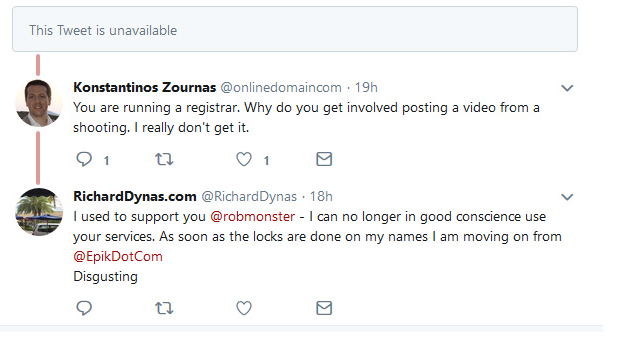
I don't suppress speech, and I'm not a hypocrite on this topic. For example, a few years ago, a fellow wrote in public that "someone should slit [my] throat like a pig". (He didn't like my forecast about a bubble in the Chinese domain market, as I recall.) Konstantinos Zournas (on whose blog the comment appeared) wanted to remove the post, since it was akin to a death threat; but I asked him to let it remain. People are welcome to say negative things about me. But don’t be surprised if I respond and dispute what is said – particularly if it’s nonsense,
@cyc.
Everything is fair game for critique:
Hate speech is speech that you hate.
No, that's not a helpful definition. "Hate speech" has a narrower meaning, which is pretty clear. It's not any statement that someone hates. Rather, it is speech that is
hateful toward some group.
Thus, when someone says they want to see me murdered, that is not “hate speech” even though their sentiment isn’t particularly friendly. That’s because I’m not a
group. The violence is only aimed at me as an individual. So it’s outside the definition.
Another example: I personally hate everything that is said by Trump apologist Kelly Anne Conway, who wriggles and deflects in an incessant sleight-of-hand to distract from the question and spread disinformation. But much as I hate listening to her or to Giuliani or to Lindsay Graham, what they say isn’t “hate speech” merely because it annoys me. To be “hate speech”, according to the way this phrase is normally used, it would need to be hateful toward some group.
When Rwandan radio advocates a “final war” to “exterminate the cockroaches”, that would clearly be hate speech, even if the genocide had been averted, because the purpose of such remarks is to promote hatred of a group:
http://news.bbc.co.uk/2/hi/africa/3257748.stm
Ditto antisemitic propaganda leading up to the holocaust (and since). Ditto the rhetoric surrounding ethnic cleansing of Bosnian muslims. Or more recently, the hate speech aimed at Rohingya muslims who have fled violence in Myanmar.
Closer to home, if someone justifies Trump’s “muslim ban” in ways that denigrate muslims, then that might be simple xenophobia. But if it is more inflammatory, then it might deserve the “hate speech” label because the intent would be to spread hatred, which has led to arson, assault, and murder in the USA. Or if someone justifies Trump’s mythical wall in terms of expelling “dirty low-IQ hispanics”, then that would be so derogatory that the “hate speech” label will be applied by many of us. Certainly, when torch-carrying white nationalists march chanting “jews will not replace us”, the nation needs to debate the topic of “hate speech”.
There is no perfect agreement about which statements are “hate speech”. But the general idea is fairly clear. The basic meaning can be shared even by people who disagree about the world. They can debate when to apply the label. And they may question how useful the label really is. Yet both sides in a debate need to accept the meaning of terms in order to communicate.
Suggesting that “hate speech” is really just any statement that someone dislikes isn’t helpful because it conflates ordinary disagreement, broadly speaking, with something much less common and far more dangerous: bigoted rhetoric that targets some group, implying that members of that group are inferior or evil and that they deserve to be the targets of violence or repression. The phrase “hate speech” should be a helpful shorthand for that kind of bigoted rhetoric.
I understand why Rob says that, these days, “hate speech” is overused and diluted to the extent that it means only everyday disagreement. It’s true that some people on the Left tend to resort to this label to pillory their opponents. Often they round up from ordinary prejudice to full-blown “hate speech” when condemning someone’s remarks. Yet there are many people who have old-fashioned ideas about race, homosexuality, women, or foreigners. They don’t need to be excused for making racist or sexist or xenophobic or bigoted remarks. But if their intent isn’t to advocate repression or violence, then the label “hate speech” is unreasonably extreme.
We can agree on the basic meaning of “hate speech”. And when people use it inaccurately, we should say so. For the phrase to be useful at all, it can’t be overused.
Recognizing a category of speech as “hate speech” for purposes of discussion does not necessarily imply making it illegal, though some countries have made it a crime. Personally, I think that’s a slippery slope. I’d prefer to see hate speech permitted and publicly condemned. Advocating overt violence can be illegal, and that can be separated from remarks that are otherwise hostile to a group. This is debatable, of course. But it seems to me that society needs to allow criticism of groups. If mere hostility to a group becomes a crime, then that mechanism won’t only be used for suppressing the bad guys. It will, sooner or later, be twisted to suppress the good guys too.