
NameSilo

analysis Is Domain Name Investing Profitable?

SpaceshipSpaceship
Watch
Impact
53,963
In a recent NameTalent post an analysis is made of how profitable domain name investment is on average. The starting premise is:

"A domain investment will be profitable if the probability that the domain name sells in any given year multiplied by the net profit on the sale of that domain name is more than your annual holding costs associated with the domain name."

For example, if your net profit (i.e. after costs considered) on a domain name is expected to be $1500 and your probability of selling in any one year is 1/100, then the investment is profitable if your annual holding costs are less than $15.

I used sales data and number of domains listed for sale to estimate the probability of a sale. I did this for all extensions together (and data for the last year), but the market is so dominated by .com that .com alone numbers would not be much different.

A correction factor must be applied for the fraction of total sales that NameBio stats represent. I used a factor of 5 (i.e. 20% of total sales are on NameBio). With this factor it suggests that the chance of any one domain name selling in one year is 1/73. So if your portfolio is 350 you would sell about 5 domain names per year.

In the initial work I used the NameBio average selling price. There are arguments that NameBio may under-estimate average prices (wholesale price bias), or that by including the super premium sales it may over-estimate the value expected by a typical domain name investor and we should use the median price.

For costs I assumed commissions at 10%, other selling costs, and a cost for the time the domainer puts into handling the name. Note that while I take into account most types of costs, things like a portion of Efty memberships or web hosting costs are included with renewal fees in the annual costs, rather than applied in the net profit line. Clearly it could be done either way, as long as consistent.

I applied this relationship using several different models as shown in the table of results below.
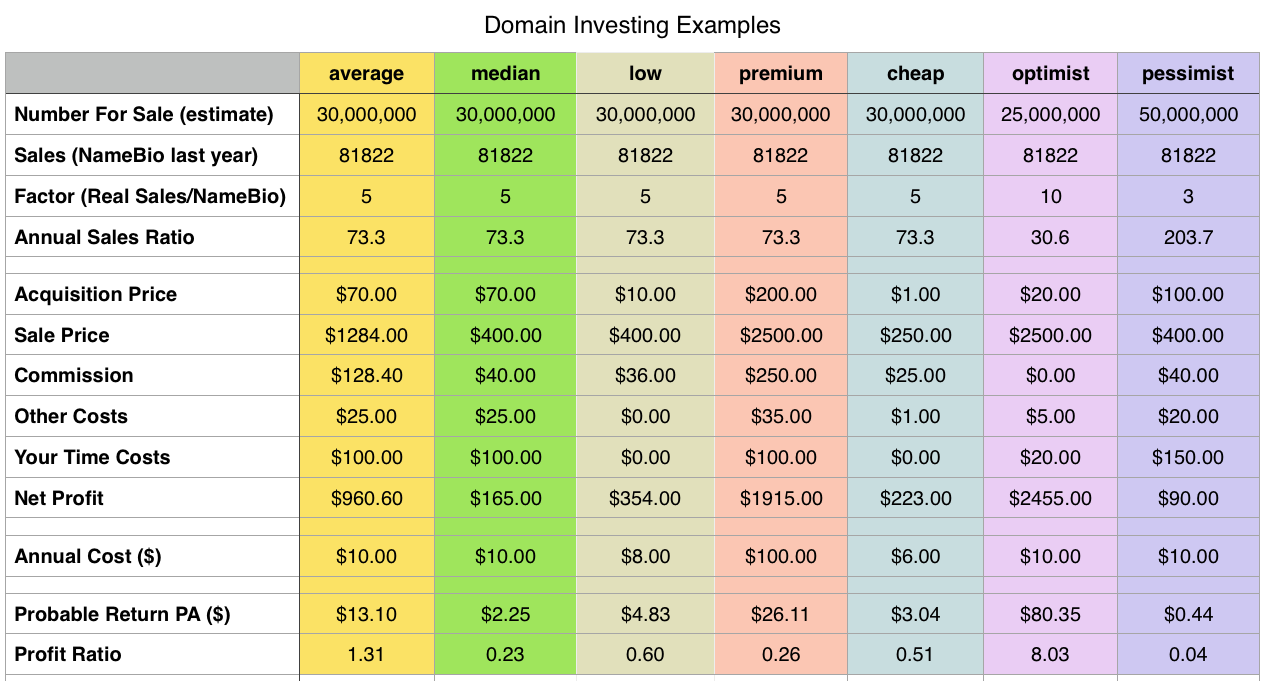
ProfitModels.png

The first (yellow) average model is my best estimate. I assume that you buy the domain at $70, sell at NameBio average, pay 10% commission and $25 other costs (this includes a portfolio averaged cost for things like legal, financial, art, evaluation fees, etc.). Arbitrarily I assume that you should get $100 for the time you put into handling acquiring, promoting, maintaining and selling (maybe 4 hr at $25 per hour). You also gain by any profit in bottom line. I assumed a pretty aggressive $10 annual cost assuming you have some sort of volume discount on renewal and have a big enough portfolio that your web costs are small (or you use only marketplaces). The final row in the table gives you the net ratio - e.g. in this situation it suggests profitability with a 1.31 ratio (below 1 means you lose money, on average).

Under median I kept most things the same but I assume that you sell at the median, rather than mean, price. The NameBio stats don't allow you, anymore, to calculate it for the entire large dataset, but when I do it individually each day it is usually in the $275 to $400 range. I used the upper value. Here we see things are not profitable.

The low model assumes you buy at reg fee, sell at median price, reduce commission to 9% and keep other costs and the cost for your time at $0. Even at this not quite profitable.

Premium is meant to apply to a premium ngTLD or premium country code situation. Assume somewhat arbitrarily you buy at $200 with $100 annual (mainly renewal) fee. Here assume that you sell at about double the average price, $2500.

Some of us start in domain investing by hand registering some inexpensive ngTLDs. The cheap model simulates this. I assume that you buy at $1 and manage (perhaps with multi-year discounts) to keep renewal at $6. But you only sell at $250 and don't value your time. The probability of sale should probably be reduced, which would make the situation even less favourable.

The optimist and pessimist models are meant to look at what might be the bounds of the likely models. Optimist assumes that really only 10% of sales are in NameBio, you sell at about double NameBio average, you sell directly without commissions and don't add much for your time. The result is very optimistic with a ratio of 8 :xf.smile:. For pessimistic, well pretty pessimistic :xf.frown:.

You can read the full post at NameTalent at this link:

https://nametalent.com/2018/10/is-domain-name-investing-profitable/

Keep in mind that these are probabilistic arguments for the domain business as a whole. Clearly many successful investors will do better than this, while a number will do worse. Also, I totally accept that some of the numbers (like the NameBio correction factor) are uncertain.

Thanks for reading!

Bob
 
31
•••
The views expressed on this page by users and staff are their own, not those of NamePros.
GoDaddyGoDaddy
What you are doing is similar to this : You get the full database of NBA games and notice that the Home team has some advantage (over 100,000 matches). Let's say the Home team wins 55% of the time and the Away team only 45% of the time.

Now there is an NBA game later tonight, so without knowing which teams are playing, you estimate that the Home team has a 55% probability to win (which is correct, absent any further information). But someone who checked the fixtures and knows which teams are playing (could even be a David vs Goliath case) is in a better position to estimate the probabilities of the outcome. Because they have this extra piece of information.

That's why I say your method is inefficient.

In our case, domains, this extra piece of information is the domain itself.

The formula you posted treats the probability of a sale in a uniform manner over all domains (ie. as a fixed number). It is inefficient. It is way more efficient to estimate the probability of a sale for each domain individually. Moreover, this probability is dependent on the BIN or asking price (obviously).

There are other inaccuracies in your post too. Sorry to have to say that, because I know your intentions are the best. And I know research and publishing takes a lot of time too. But some people may take everything at face value and act on these findings.
 
3
•••
Thanks for laying out your reasoning of what you meant by inefficient @Asfas1000. I agree that this is exactly like your NBA home team example.

I think everyone on here agrees that the domain name matters in the probability for selling (and price). Now the formula itself (but not the numbers) can apply to an individual domain name as I explain in the OP:

For example, if your net profit (i.e. after costs considered) on a domain name is expected to be $1500 and your probability of selling in any one year is 1/100, then the investment is profitable if your annual holding costs are less than $15.
Yes, absolutely, if you can from experience, other information, whatever, estimate the probability for each individual domain in your portfolio, and estimate the expected price, then you can decide on whether each domain in your portfolio makes sense as I did in the example above.

The article deals with how, on average, people do. The article at the link starts with the following where I lay out why I went through the effort of developing a model. I was concerned that too many jump into domaining unrealistically expecting easy big profits. I wanted to see what the average numbers say.

I am concerned when I read posts from new domain investors saying something like “I registered 20 domain names last month and they have not sold. What am I doing wrong?” or “I just quit my job and plan to make easy money flipping domain names.” Some of the books written on domain investing perpetuate the myth that it is fast and easy to make big returns in domain investing. Let’s take a look at what the numbers really say about how profitable domain name investment is on average.

The purpose is foremost to look overall at the profitability of the industry, and then I looked at different models within that partly to set bounds between say the most optimistic and the most pessimistic models.

I am working on a future post on exactly the idea of applying the formula to individual names in your portfolio. However, as background to that I think it is valuable to look at the industry wide numbers. Otherwise, I think it would be too easy to fool ourselves into unrealistic expectations, say I have 1 chance in 2 to sell this domain this year for $10,000. I think is is important to see how rare that would be. I also of course offered in the thread if anyone wants a set of numbers they feel apply to their situation run to do that.

You mention inaccuracies without being specific. If you share anything I am glad to respond. I would point out that the linked article takes some time in pointing out some of the uncertainties, and also that things like investment costs on borrowed money are not included.

Bob
 
Last edited:
1
•••
it's more complex

as the profitability is not only gained by a sale
but the domain meanwhile may have income based on its traffic

additionally the domain sold must pay for the other thousands unsold domain renewals

the question is:
can you sell a sold domain high priced enough
to make it work as whole
 
Last edited:
2
•••
as the profitability is not only gained by a sale
but the domain meanwhile may have income based on its traffic

Thanks @frank-germany. I should have stated that I assumed no parking or similar revenue. If you do expect revenue, a simple way to enter in model is simply subtract from annual costs. That is if your renewal is $9 other annual costs $1 but expect to earn $6 parking, the annual effective cost is $4.

The model does already handle the maintence cost of the rest of your portfolio.

Bob
 
3
•••
This model ?
 
0
•••
0
•••
Heavy!

I guess with gambling, the bookmakers do pay out 80% of their takings. So a good few make in that game. Not sure domaining is so far behind.
 
Last edited:
1
•••
Isn't the basics simply if you sell for more than you purchased, incorporating any expenses in the purchase price including lost interest,renewals etc, then you are making a profit?
 
2
•••
Isn't the basics simply if you sell for more than you purchased, incorporating any expenses in the purchase price including lost interest,renewals etc, then you are making a profit?

It can't be that simple. If it was that simple, then everyone would be using those metrics.
 
Last edited:
0
•••
It can't be that simple. If it was that simple, then everyone would be using those metrics.
You mean the simplicity of buying something for one price and selling for a higher price is a difficult concept?

The concept is easy to understand, it's the doing that is the difficult part,not just with domain names.

Mr Micawber cracked it years ago.
 
Last edited:
0
•••
Why can't a low model that is hand reg sell for an average price $1200? Let say you have 5000 domains, 35000 USD investment , even you manage to sell 1% for $1200 avg price which I think it's achievable, your already in profit per year ....
 
1
•••
your probability of selling in any one year is 1/100

This probability I will never understand. Reason:
(Inventory A): a portfolio of 3/4 worders, misspellings, out-of-date keywords, hyphenated, and l33t names. Not to mention the dead ngTLDs.

This kind of inventory should not have the same probability of selling anywhere close to someone who has (Inventory B): hand-picked names of "quality".COMs ie. dictionary one-worders, 2/3 characters, 4 letters(?), and up-to 5 digit numerics, 2 keywords that go well together, catchy/pronounceable brandables, strong GEOs, and niche names that are in the market now or in the near future.

Looking through expired lists, 90% of it are names that fall under 'Inventory A'. This kind of names is bringing the whole 'percentage of selling' down imo.
 
1
•••
This kind of inventory should not have the same probability of selling anywhere close to someone who has (Inventory B): hand-picked names of "quality".COMs ie. dictionary one-worders, 2/3 characters, 4 letters(?), and up-to 5 digit numerics, 2 keywords that go well together, catchy/pronounceable brandables, strong GEOs, and niche names that are in the market now or in the near future.

Yes I agree @Jay Ha The figures are the probability (estimate with significant uncertainty) for the whole universe of domain names for sale. Of course some name/price combinations will have a probability of essentially 1 of selling in a year (i.e. will sell for sure), while others will be very near 0. My hope is that these models and figures would provide a reference for comparing our own holdings. Most skilled domainers would justifiably use figures above the average. Some (not all!) newcomers should probably build a model at or slightly below the average in doing their business plan.

Why can't a low model that is hand reg sell for an average price $1200? Let say you have 5000 domains, 35000 USD investment , even you manage to sell 1% for $1200 avg price which I think it's achievable, your already in profit per year ....

It absolutely can @Brand Ultra.This is just one attempt at seeing what the results would be for different models. People do (at least occasionally) turn hand reg into very high figure sales.

I guess with gambling, the bookmakers do pay out 80% of their takings. So a good few make in that game. Not sure domaining is so far behind.

Nice way to succinctly summarize @domainer111 ! I think the numbers are still uncertain enough to be sure, but I was surprised how close my "best estimate" model came to being break even (it was slightly better than break even). I suspect that does reflect our business overall, a few make a lot, but the vast majority either slightly make a bit or slightly lose a bit.

Isn't the basics simply if you sell for more than you purchased, incorporating any expenses in the purchase price including lost interest,renewals etc, then you are making a profit?

Yes. Exactly. Predicting which names will do that is the hard part of course :xf.wink:! The analysis tried to see if overall the industry (or at least domainer part of it) is managing to make a profit. The clear answer? Maybe, Maybe Not ! :xf.grin:

Seriously thank you all for the input, suggestions and comments. A key part to domain success, imho, is being open to new ideas, but challenging ideas with a critical (in the sense of questioning, not in the everyday sense of being negative re everything). Thanks again.

Bob

 
Last edited:
2
•••
There is a considerable gap between typical domainer pricing and typical end user willingness to pay for a domain name. There are end users paying six figures annually for PPC advertising yet their budget for domain names is $xx. Or the real estate agency in downtown West Palm which is likely paying six figures for their office space in a high rent area but operates on a double hyphenated domain name. If we base pricing on ability to pay then any inquiry gets priced at $5k but since most people view domains like cheap electronics ($XX to low $xxx at best) how sensitive are sales to pricing? Registry sales are not what the typical domain investor realizes. Yet we cannot exclude domainer to domainer sales as more than 80% of my sales over the last ten plus years were to either investors or unmotivated end users who did nothing with the acquisition.
 
2
•••
Your commission schedule at 10% is much to low, it should be at least 15%, but many exchanges are charging 20-30%.
 
1
•••
Your commission schedule at 10% is much to low, it should be at least 15%, but many exchanges are charging 20-30%.

I do realize that some are higher, but it is also true that a number of sales are taking place at locations like Undeveloped that offer 9% commission, privately via outbound without commission, and on Efty sites, again without commission. Also a number of the registrar marketplaces are 10% and less. My figure of 10% was an attempt at some sort off average over all venues, but thank you for your opinion that it should be higher.

Bob
 
0
•••
Interesting macro view of it all. It's funny that just a few days ago I actually stressed in another thread a huge factor that most people don't consider when building their portfolio is that equally important to profit, is indeed probability of sale. On an individual level this number is virtually impossible to predict .. but it's interesting to see the numbers you assumed in your calculations at a large macro industry level.

I'm not sure most people understand that your model is in no way meant to estimate individual portfolios and even less individual domains. It's simply meant to give us a global guesstimate of the overall industry. Your model already makes too many guesses and assumptions to be realistically reliable (I don't mean that in a bad way, it's just that obviously most of the information/data required for such a model to be anything even close to accurate simply is not available) .. then the more you get into individual portfolios and domains, the more vastly randomising factors come into play.

That being said .. older domainers should already have a model of their own using the numbers from their own portfolio .. that shouldn't be too hard if you have a few years of your own sales data ... from that you can get a vastly more accurate profit prediction model (although obviously there is still a lot of randomness and dumb luck involved depending on your names and pricing .. lol).
 
3
•••
@Ategy, I agree with what you said below - it seems lot more concrete than the other methods.

That being said .. older domainers should already have a model of their own using the numbers from their own portfolio .. that shouldn't be too hard if you have a few years of your own sales data ... from that you can get a vastly more accurate profit prediction model (although obviously there is still a lot of randomness and dumb luck involved depending on your names and pricing .. lol).
 
Last edited:
0
•••
Hi,

I think you have embarked on a good journey. What I am not sure of is your direction. What you might consider in the future is really taking a closer look at “data integrity”. It would be great to see someone analyzing how many sales are to valid end users to resolve to actual websites and not parking pages, and making a list of those reported on weekly sales reports and databases and later fell through or were “discovered” simply between investors. The data on true end user sales for websites gets mixed in with those statistics. Even if Disney say buys a domain and simply parks it, it might be irrelevant as it was a defensive purchase or future project. I have for the past year found way too many “news” reports that when I went to look at the “website”, or “owner” via whois- its disappointing. No website, same nameservers, parked pages, lots of suspect data.

Often it seems end users do not want their sales price info published, but it doesnt mean the website is to remain a secret. Perhaps it is difficult and so the majority of this data published is domainer to domainer sales. I know many people on this forum consider that a “sale is a sale”, personally imho the wholesale part of this business is irrelevant. Just because someone sells a name to another speculator does not show the health of the internet and web use and development of the actual market.

Since you really want to look into statistics, It would be nice if you could be highly critical of the data and filter out the “noise”. It would be nice to see a new blog that was really honest about real news of end user websites built on great recent names purchased, not of $xxx,xxx sales sold to well heeled investors or to prop up some brokers or anyone bought names on speculation. I find only a few blogs that report the end user sales for real websites.

Even $xxxx sales to end users who develop are interesting. All vertical markets have sales and knowing about development segments adds to the integrity market trends and of market growth of the internet as a whole. Glad to see a new blog and data resource. Keep at it!
 
6
•••
Hi,
Even $xxxx sales to end users who develop are interesting. All vertical markets have sales and knowing about development segments adds to the integrity market trends and of market growth of the internet as a whole. Glad to see a new blog and data resource. Keep at it!

But other thing is, most end user projects don't work out commercially. That's the reality.
 
2
•••

We're social

Spaceship
Domain Recover
CatchDoms
NameMaxi - Your Domain Has Buyers
  • The sidebar remains visible by scrolling at a speed relative to the page’s height.
Back



