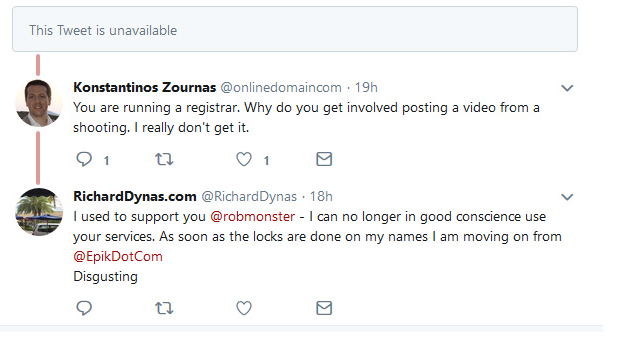
What's going on with Epik and Rob Monster?

SpaceshipSpaceship
Watch

MapleDots

Account Closed (Requested)
Impact
13,186
I'm catching the tail end of this, seems to be some kind of controversy...

https://domaingang.com/domain-news/rob-monster-off-twitter-after-christchurch-massacre-controversy/

Must be something odd to evoke this type of a response from one of our members.

Picture0016.png
 
9
•••
The views expressed on this page by users and staff are their own, not those of NamePros.
.US domains.US domains
But any intelligent person can see that the analogy is highly flawed.

For a start god created the tenants. He designed them and decided upon their nature.

Secondly, he knew exactly what the tenants would get up to, because he knows exactly what the future holds. Despite this, he still rented to them.

Thirdly, he refused to give clear rules to begin with, instead choosing to leave the new tenants riddles, stories and anicdotes, many of which contradicted each other.

When the tenants asked for clarification, God said he would not be willing to explain things further, and that they should just hope that they were doing things correctly.

Actually, when they tried to call him he didn't even answer. And they began to wonder if there was even a landlord to begin with.

Then they found thousands of old lists of rules, from people claiming they used to be the landlord. These were equally confusing.

You got to do better than this, Rob.

The tenants in this story have free will just as we all have free will. The landlord in this story is secretly the ancestral parent of the tenant and is really hoping the tenant will be not just a good tenant but also a success story that the whole town will remember as a shining example of someone who the town thought was a lost cause, but turned him into an esteemed member of the community.

As for your riff on my "parable" of people finding more rules and more rulebooks, indeed that did happen in history where you had countless false prophets claiming inspired knowledge and leading more folks astray. And indeed, many people are wondering if there is a landlord, and are wondering if there is even a legitimate rulebook at all. That is ultimately what leads to anarchy, which in turn leads to dictatorship.

As for why God wrote in anecdotes and parables, and why He used types and shadows, rather than prescriptively and literally writing out the exact script, that is a mystery, and is a fair question. I believe there are many actors in this converging drama of the ages that do have relatively exact scripts that they are following. They "prophesy in part". The whole drama converges at the Day of the Lord.

Now when it comes to fulfillment of prophecy, you could say "why does anyone have to be the bad guy", or "why does anyone have to be one of the guys that dies". And that is precisely why God gives everyone free will, e.g. when He says about Mystery Babylon: "Come out of her, my people, that ye be not partakers of her sins, and that ye receive not of her plagues." (Revelation 18:4).

Indeed, giving us fair warning is is what I would expect a benevolent dictator would do. That is what He did before the destruction of Sodom and Gomorrah, the flood of Noah, the Babylonian captivity, and the crucifixion. Like it our not, God is consistent and gives us plenty of fair warning before he finally calls people out for their bullshit, once and for all, and runs the world from Jerusalem for 1000 years.
 
0
•••
This is a very worthwhile read:

https://blockonomi.com/online-censorship-decentralized-content-distribution/

It discusses the various tech trends on decentralization that are maturing, largely as a result of over-reach of censors and centralized control of digital publishing.

The article also referencing Blockchain-based domains, which is still a bit of a curiosity but not nearly mainstream. The technology to make it mainstream is ready, awaiting a catalyzing event.

The censors will do well to resist the temptation to overreach. As with BitCoin, there comes a tipping point where you can no longer put the genie back in the bottle! At that point, you can only try to regulate it.

My continuing bet is that conventional domains can be made resilient against censorship, thereby avoiding the need for trustless alternatives. That is the essence of Epik's resilient domain initiative.
 
Last edited:
1
•••
You could have two groups living in the same society that are pit against each other because the core tenets of their religions are so opposed to each other. Those issues might not always be so crucial to the society, but if they were, how could those people ever work out the difference?

That has happened throughout human history. Often, the conflicts have been bloody. Consequently, we evolved secular, pluralistic societies as a solution for coexistence.

Democracy doesn't imply a pluralistic society. Majority vote could, and often does, mean tyranny of the majority, who enforce their worldview on minority groups, despite disagreement. Actually, throughout history, many of the pluralistic societies where minority religious groups thrived were non-democratic (with kings) and non-secular (with an official religion).

Democracy doesn't imply a secular society either. Many countries today are democratic, yet they may have an official state religion. Meanwhile, totalitarian regimes, which are decidedly undemocratic, have often been secular.

A secular society doesn't mean a society where religion is excluded from governance, though some countries (like France) have pushed religion to the margins in ways that are repressive. Having a secular society simply means establishing a government that has no official religion and which is not organized in favor of or against any particular religion.

The earliest advances toward pluralism and secular society were made by religions themselves. For example, "Render unto Caesar that which is Caesar's" (Christianity circa 100 A.D.) and "There is no Compulsion in Religion" plus recognition of Jews and Christians as fellow "People of the Book" (Islam circa 600 A.D.).

Ultimately some contradictions between religions can only be resolved by making government independent of all religions. That is the basis of the Constitution in the USA. The English colonies were full of so many religious sects, and the colonists were keenly aware of the history of war and religious persecution in England and Europe, that they decided to protect their own religious freedoms by making a religiously neutral government in each state and later in the federation of states.

Many of the founders who participated in writing or ratifying the U.S. Constitution were Deists, which is as near as that age could come to Agnosticism or Atheism. Some of them weren't christians exactly. But they still believed in a Creator, albeit a hands-off Creator. Overall, the Americans formed a secular pluralistic government ... for religious reasons.

Religions contradict one another. Sometimes those conflicts have led to bloodshed. And sometimes they have led to treaties, to pluralism, to secular society – indeed to the innovations in government that we enjoy today. Observing the way our secular, pluralistic societies emerged (from a religious era and for religioius reasons), it is abundantly clear that contradictory religions can and do find ways to coexist. They don't always do so peacefully. But they have done so peacefully, off and on, and better and better, for thousands of years.

I would add one observation: Governments that were founded as officially unreligious (as opposed to religiously neutral) have proven to be very repressive. Take the Soviet Union, for example. That's not to say that religiously neutral governments (like the USA) haven't also been repressive. Clearly the USA has historically persecuted religious minorities (like Mormons and Muslims) as well as other ideological positions (like Marxists), to say nothing of ethnic and other minorities. But those persecutions can be seen as deviations, and the society has (sooner or later) discontinued them because they are contrary to (what are meant to be) its principles.
 
Last edited:
1
•••
Like it or not, the world is pretty disturbing.

The world is incredibly disturbing. How disturbing do you want to go in this thread? Must you post any of the disturbing things people are capable of committing or inventing?

You have posted the video of a killer murdering innocent people in a Mosque in cold blood on the Epik platform. Is that disturbing enough? Hope that made you some new business as you pushed Epik's services that apparently made that post secure. So go on, post some more, people. On top of that you called the incident fake.

What about the sickening abortion posts? The 14-16 week old fetus that supposedly was intentionally aborted. Do you think people would actually talk about stomping it, kicking it so it would stick to the wall, calling it a bug, or some other grotesque description? Do you think that was real? So according to you, this was real and the Mosque killing was fake?

How do you determine what is real and what is fake?

It is incredible to me that a CEO of a company like Epik would post such horrific incidents to either promote services or promote some personal agenda.
 
Last edited:
1
•••
This is a very worthwhile read:

https://blockonomi.com/online-censorship-decentralized-content-distribution/

It discusses the various tech trends on decentralization that are maturing, largely as a result of over-reach of censors and centralized control of digital publishing.

The article also referencing Blockchain-based domains, which is still a bit of a curiosity but not nearly mainstream. The technology to make it mainstream is ready, awaiting a catalyzing event.

The censors will do well to resist the temptation to overreach. As with BitCoin, there comes a tipping point where you can no longer put the genie back in the bottle! At that point, you can only try to regulate it.

My continuing bet is that conventional domains can be made resilient against censorship, thereby avoiding the need for trustless alternatives. That is the essence of Epik's resilient domain initiative.

I'm a big fan of crypto, smart contacts and blockchain (for certain things). But religion is the ultimate censor, historically speaking - so you're sort of batting for both teams here.

That said, I suspect in your case Rob, what you're really interested in is the freedom to spread lies that are detrimental to society unchallenged.
 
Last edited:
0
•••
I'm a big fan of crypto, smart contacts and blockchain (for certain things). But religion is the ultimate censor, historically speaking.

Sadly in your case Rob, what you're really interested in is the freedom to spread lies unchallenged.

Blockchain will have its place, notably in the area of crypto currencies. I also see immediate potential for decentralized file systems, e.g. IPFS. I also like the idea of general ledgers that are self-auditing and self-governing, e.g. for tracking shared ownership of digital assets.

Ironically, Blockchains might come with a privacy trade-off. Every transaction comes with a non-fungible audit trail. The forensic implications there remain to be fully understood. Those who choose to use Blockchain for vice and unlawful activity may still have a rude awakening in their future.

As for my motives for supporting lawful free speech, you are actually speaking nonsense. For example, in case not aware, I was raised in a secular household. I came to Christ as an adult based on a diligent, unbiased and objective search for truth. I view digital censorship as the modern equivalent of book-burning.

My strength of conviction about why the world works the way that it does is a direct function of my certainty that I found certain themes of eternal truth. Those who know me, know this is not new. And for the moment, people are still free to investigate the topics being discussed and form their own opinions.
 
0
•••
Blockchain will have its place, notably in the area of crypto currencies. I also see immediate potential for decentralized file systems, e.g. IPFS. I also like the idea of general ledgers that are self-auditing and self-governing, e.g. for tracking shared ownership of digital assets.

Ironically, Blockchains might come with a privacy trade-off. Every transaction comes with a non-fungible audit trail. The forensic implications there remain to be fully understood. Those who choose to use Blockchain for vice and unlawful activity may still have a rude awakening in their future.

As for my motives for supporting lawful free speech, you are actually speaking nonsense. For example, in case not aware, I was raised in a secular household. I came to Christ as an adult based on a diligent, unbiased and objective search for truth. I view digital censorship as the modern equivalent of book-burning.

My strength of conviction about why the world works the way that it does is a direct function of my certainty that I found certain themes of eternal truth. Those who know me, know this is not new. And for the moment, people are still free to investigate the topics being discussed and form their own opinions.

But do you accept that religion, specially your religion, has gone out of its way to censor and limit debate for centuries? I'm not saying that you personally have, but the religion as a whole.
 
0
•••
But do you accept that religion, specially your religion, has gone out of its way to censor and limit debate for centuries? I'm not saying that you personally have, but the religion as a whole.

I am quite sure that you are conflating Bible-believing Christians with all manner of hirelings that may or may not be willfully aligned with specific organized agendas, e.g. ecumenism.

In the US, you likely know that most "churches" are 501(c)3 corporations. The contractual condition of maintaining this tax-free status includes such things as:

- Avoid any purpose that praises or calls for discrimination
- Avoid giving input on political topics

The full list of IRS conditions can be seen here.

Said another way, most US churches have sold out to an economic model that implicitly restricts their ability to fearlessly explore and discuss truth.

You are correct that there is a history of censorship within the institutional church. Most Bibles omit many worthwhile texts. Personally, I have recently been using an independently published masterpiece:

https://cepher.bible

It includes very helpful books like Jubilees, Enoch, Jasher, Maccabees that were excluded from the Canon. Many of these non-Canonical books were found at Qumran starting in 1946, aka "The Dead Sea scrolls".
 
0
•••
I am quite sure that you are conflating Bible-believing Christians with all manner of hirelings that may or may not be willfully aligned with specific organized agendas, e.g. ecumenism.

In the US, you likely know that most "churches" are 501(c)3 corporations. The contractual condition of maintaining this tax-free status includes such things as:

- Avoid any purpose that praises or calls for discrimination
- Avoid giving input on political topics

The full list of IRS conditions can be seen here.

Said another way, most US churches have sold out to an economic model that implicitly restricts their ability to fearlessly explore and discuss truth.

You are correct that there is a history of censorship within the institutional church. Most Bibles omit many worthwhile texts. Personally, I have recently been using an independently published masterpiece:

https://cepher.bible

It includes very helpful books like Jubilees, Enoch, Jasher, Maccabees that were excluded from the Canon. Many of these non-Canonical books were found at Qumran starting in 1946, aka "The Dead Sea scrolls".

It's all still nonsense, Rob. Constant reinterpretation. And as far as I'm aware many dislike that version of the Bible.

Religion is a philosophical, moral and intellectual dead end. It provides short term comfort at the expense of long term enlightenment. You are all so predictable too..

For example, if I asked you to explain dinosaurs, I suspect you'd tell me that they were all killed as part of the flood. You'll dismiss all carbon dating techniques as flawed and claim that our understanding of the fossilisation process is also flawed.

You're also the type of person that will try and misrepresent the "soft tissue" (actually preserved as polymers with no viable DNA) retrieved in the early 2000s from some dinosaur fossils as evidence that they are younger - ignoring the scientific literature that explained how this can happen. Again, if you do acknowledge the latter at all, you'll claim it's a conspiracy or the scientists are all wrong.

Am I right?

I mean, it's an improvement from when you guys denied dinosaurs existed at all, or that they were planted by God to test our faith, but it still requires the suspension of logic and interlect - presumably the things you believe God gave us to elevate us above the (other) animals.

There is nothing about religion that encourages discovery. It is purely concerned with preserving itself.

As the saying goes... You're almost an atheist anyway. You've already rejected thousands of other gods. I've just rejected one more...
 
Last edited:
0
•••
someone-is-wrong-on-internet.png
 
2
•••
But do you accept that religion, specially your religion, has gone out of its way to censor and limit debate for centuries? I'm not saying that you personally have, but the religion as a whole.

Another flat-footed argument from a fellow impervious to facts.

What you are trying to imply is two-fold: (A) that religion necessarily causes censorship, and (B) that no religion implies no censorship.

Both of those claims are false, as can be easily verified. And your argument itself is flawed.

You point to a censorship throughout past human history, and you correctly point out that Religion was involved. But censorship is simply a feature of human intolerance, conservatism, and political power struggles – with or without religion. Any 3-year-old can shout "Shut up!" without God. So can any 60-year-old who fears change or fears a rival.

100% of people throughout those past centuries were religious. So it must be true that all their crimes and flaws were caused by religion, right? Not only their censorship but their wars and their bad hygiene. Without religion, all those societies would have celebrated dissidents, lived in harmony without armed conflict, and washed their hands with soap before meals.

Atheism only became possible within the past 100 - 200 years, roughly. It doesn't take a genius to see that your argument is based on an unfair comparison between modern times (no Religion) and the distant past (Religion). Given the history of human progress, most comparisons between modernity and the past will be unflattering to the past. Your insinuation is that Religion caused the vices of the Past:

religion, has gone out of its way to censor and limit debate for centuries

But anybody in the past who wanted to censor ideas would necessarily have been religious because 100% of people were religious. You cannot infer from this that atheists are exonerated from censorship. They didn't exist, and they didn't exercise power during that period. If there had been atheistic societies in medieval times, it's reasonable to expect that they would also have engaged in censorship, war, slavery, and torture. They also would have failed to use soap.

Any scientist would discard your argument in a heartbeat. You cannot compare a primitive or medieval or pre-enlightenment era that was religious with a post-enlightenment modern era that is less religious and expect to have isolated the variable of Religion itself.

No, no, no. In order to make any legitimate inference, you must try to isolate one variable and keep the other factors similar. So a more accurate comparison would be between religious and non-religious societies where both exist alongside one another in the modern era.

Non-religious people only became numerous enough to constitute a non-religious society a century ago, with the Soviet Union:

https://en.wikipedia.org/wiki/Religion_in_the_Soviet_Union

As we all know, Soviet Russia – being an officially anti-religious, secular state – was completely free from censorship, repression, intolerance, and war. As Solzhenitsyn documented, the Soviet Union was a utopia; and the gulags paradisiacal vacation resorts.

In case the sarcasm isn't palpable enough, that's a refutation of the 2nd prong of your argument:

(B) that no religion implies no censorship.

So is modern China, where censorship under a non-religious government is severe. We could go on and on. Your attempted gotcha was this:

religion, has gone out of its way to censor and limit debate for centuries

But in the century since non-religious societies have emerged, there has ALSO been severe censorship and repression by the non-religious. Observably, the presence or absence of religion in a society does not determine how much censorship will exist.

Religious people have engaged in censorship, definitely. But remember that 100% of people during that era were religious. So the victims of that censorship were ALSO religious people. So the crime cannot be ascribed to Religion itself. That would make no sense.

A religious person censors another religious person and cites Religion as the justification. Clearly that proves that Religion causes censorship. Right?

OK. Let me give you another instance of that logical argument: A homeless person murders another homeless person to steal his shoes and cites Homelessness as the the justification. Clearly that proves that Homelessness causes murder. Right? Never mind that people with homes also murder. Never mind that the victim was also homeless.

Or to put it another way: Religion causes censorship because religious people have censored other religious people and because they claim Religion made them do it. Never mind that non-religious people also censor their opponents. Never mind that the victims are also religious.

The first prong of your argument is also false:

(A) that religion necessarily causes censorship

Freedom of speech and of the press emerged hand in hand with freedom of religion. In other words, protections against censorship emerged in religious societies because of the importance of religion itself. If religion itself causes censorship, then that would have been impossible.

It's a piece of cake to find religious countries like Iran or Saudi Arabia where censorship exists. But that doesn't imply that Religion necessarily causes censorship nor that non-religious societies don't also engage in the same degree of censorship. What those countries have in common – aside from religion – is tyrannical government. Perhaps it is tyranny, rather than religion, that causes censorship.

Censorship and repression are basic human impulses, exercised by those in power, if that power is not checked, with or without religion. Stalin did not need Religion to justify censorship, concentration camps, torture, or the deaths of millions. Since we see the likes of Stalin in secular modern societies, it is hardly surprising that we find censorship and repression in less modern times where the people happened to be religious.

Yes, of course, religion was invoked to justify censorship. But that's also to be expected. People in any era will use whatever morality or worldview happens to hold sway in order to justify the censorship they want. In a Christian era, they would use Christianity In a Marxist era, they would use the Marxist ideology. In a Muslim country, they would use Islam. In ancient Greece, they would say Socrates "corrupted the youth". In "woke" progressive USA circa 2019, they will use the consensus worldview of "woke" progressives to ban "hate speech" or de-platform the opposition. Or in conservative christian USA circa 2019, they will use the Bible to exclude evolution, sex education, or progressive ideas about LGBTQ people from the public classroom. That's more or less how Bertrand Russell was prevented from teaching mathematical logic in the USA many decades ago – due to his progressive views about marriage. In a Dawkins-esque "post-religious" society, teaching that religion has benefitted mankind and resulted in great achievements impossible without religion might be censored from the public-school curriculum.

Any dominant worldview will be used to justify censorship. But it doesn't imply that the worldview itself causes censorship.

Religion hasn't been the only ideology that has led to repression. Marxism, of course, has. But so has Evolution and Science itself. Distorted views of Evolution have led to a predatory capitalism based on "survival of the fittest" and also to the ideology of racial superiority that peaked with genocide in Nazi Germany. Much earlier (1904-1908), Germany committed genocide in Africa that included horrendous medical experiments and was justified based on eugenics, which was a moral theory deriving from Evolution:

https://en.wikipedia.org/wiki/Herero_and_Namaqua_genocide#Medical_experiments_and_scientific_racism

The only societies that can resist censorship and repression are pluralistic societies, which are not ideologically pure but contain a mixture of incompatible world views, including religion. Such societies evolved thanks to the conflicts between religions. Freedom of speech and of the press were justified – in spite of the instability caused by dissident opinions – because of the moral imperative to pursue the truth. Ultimately, governments could not dispute that moral imperative because the truth was a religious truth; and the imperative came from a power higher than human governments. That notion is fundamentally religious in origin. In societies where the pursuit of truth is not recognized as a divine imperative, it is much easier to justify censorship for the sake of homogeneity and stability. That was the case in Soviet Russia and in modern China.

You have already been confronted by most of these facts. And, of course, you ran away from them because they threaten your dogmatism. Indeed, there are no facts and no arguments that will change your faith-based hatred of religion. But I will continue to challenge your bad arguments so that everybody can see you running away.

 
Last edited:
1
•••
[duplicate post]
 
0
•••
What you are trying to imply is two-fold: (A) that religion necessarily causes censorship, and (B) that no religion implies no censorship

Crikey, not you again. Your logical reductionism is frankly amusing at this point. Point A is true. Point B is you, yet again, injecting your faulty logic into the debate and then arguing against it. You inferred, I didn't imply.

I made no statement that a lack of religion leads to absolutely no censorship. Clearly any power structure (which all societies will have in some form or another) will have those at the top that want to maintain it, and will censor accordingly.

However, a child could recognise that Point A does not require Point B to be true.

Let's apply your logic to another random concept, to see just how silly it is...

A) Eating pancakes makes people fat.

B) A world without pancakes would be completely free of fat people.

See how rediculous that is? Please tell me you see how rediculous this is? I expect there's probably a Latin phrase for it.

Please point me to the post you think I made where I said religion was the single and only problem / negative influence in the world. I'll be waiting...
 
Last edited:
0
•••
Last edited:
0
•••
@whenpillarsfall

Of course you didn't make your argument explicit. People who lack self-awareness generally can't. Naturally, once your implied argument is made explicit, it looks foolish. That's not my fault.

I never said (A) implies (B). I said you are claiming both (A) and (B). If you cannot understand that, then you can understand nothing of what I've said. Re-read it from the beginning or give up.

If you deny that your argument is what I say it is, then make your argument explicit. Let’s see how it differs from the argument you appear to be making, which I just refuted.

Clearly you are insinuating something when you ask this loaded question:

But do you accept that religion, specially your religion, has gone out of its way to censor and limit debate for centuries?

If you believe that the absence of religion would have led to the same degree of censorship, then you are not making any point at all. So let me ask you point blank: Do you believe the presence or absence of religion has no effect on censorship?

We all know you think Religion causes censorship. Clearly you think you are making a point of some kind with that rhetorical question above. So I assume that you think Religion causes more censorship than the lack of Religion.

I diagnosed your argument as consisting of 2 claims: (A) and (B). You say that’s not your argument. OK. Which of those 2 claims do you agree with, and which do you disagree with? In what way?

It seems your only objection is that you would change the word “no” to “less”:

(B) that no religion implies no censorship.

Fine. In that case, my argument still stands and still refutes you.

If there is some other way you want to try wriggling out of the corner you’re in, please try. You are welcome to say how I erred in characterizing your viewpoint. But you will need to make your argument more explicit. Or you are welcome to dispute any of the specific claims in my counterargument.

Pretending to laugh at how "amusing" I am won't help you escape. Nor will whining vaguely about my "faulty logic". I challenged you days ago to point out a single fallacy in my reasoning, since you claimed I committed some logical fallacy. And instead of answering, you ran away.

I expect you will continue to run away.
 
Last edited:
0
•••
I never said (A) implies (B). I said you are claiming both (A) and (B). If you cannot understand that, then you can understand nothing of what I've said. Re-read it from the beginning or give up.

Yes, I know you said I am claiming A=B.

And again, I've told you that I never stated that, and that B is your own injection. I've said that the above position is rediculous, which is why I never said it.

Unless you can point me to where I clearly stated that religion is the single and only problem / negative influence in the world, you have been well and truly caught out.

Again... I'm waiting. No dodging please.

You are making a very simple allegation... Prove it.
 
Last edited:
0
•••
Yes, I know you said I am claiming A=B.

How many times do I need to explain this to you? No, I did not say that A implies B, nor did I say that you thought so. Let me now say for the 3rd time: Your argument, as I see it, is that both A and B are true, separately.

I just challenged you to make your argument explicit. And you ran away.
 
0
•••
I did not say that A implies B, nor did I say that you thought so

But yet a few minutes ago...

I said you are claiming both (A) and (B)

For the record, I am not claiming A=B or that A and B are both correct.

Point me to where I claimed A and B are both correct? Quote me...

You've well and truly walked into this one... Your reductionist nonsense has forsaken you 🤣

Unless you can tell me where I stated A and B are both correct, this debate is over.
 
Last edited:
0
•••
@whenpillarsfall

You say point (A) is true. Since I already refuted point (A), and you have made no counterarguments whatsoever, I assume you are giving up and acknowledging I am right.

You say you don't believe point (B). If it's not part of your argument, and your argument only consists of point (A), then your argument is 100% wrong.

In order to be right about ANYTHING, you must either supply a counterargument regarding point (A) or else you must find some other part of your argument that can be true – if not (B) then perhaps some modification of (B), or else some hidden part of the argument. I have now asked you repeatedly to make your argument explicit, offering you an opportunity to modify point (B) so that it better reflects your position or to find some other point latent in that insinuation of yours that I quoted.

Instead you are running away, defeated, without even trying to present a case for yourself.
 
Last edited:
0
•••
@whenpillarsfall

You say point (A) is true. Since I already refuted point (A), and you have made no counterarguments whatsoever, I assume you are giving up and acknowledging I am right.

You say you don't believe point (B). If it's not part of your argument, and your argument only consists of point (A), then your argument is 100% wrong.

In order to be right about ANYTHING, you must either supply a counterargument regarding point (A) or else you must find some other part of your argument that can be true – if not (B) then perhaps some modification of (B), or else some hidden part of the argument. I have now asked you repeatedly to make your argument explicit, offering you an opportunity to modify point (B) so that it better reflects your position or to fin some other point latent in that insinuation of yours that I quoted.

Instead you are running away, defeated, without even trying to present a case for yourself.

No, no...

You made a clear statement that I believe A and B is true.

If you want to retract it fine.

But we're not moving forward until you either back up your assertion with a quote from me, or admit you got it wrong.
 
0
•••
Dynadot — .com TransferDynadot — .com Transfer

We're social

Spaceship
Domain Recover
CatchDoms
DomainEasy — Zero Commission
  • The sidebar remains visible by scrolling at a speed relative to the page’s height.
Back