
NameSilo

discuss Startups Still Opt For Dot-Com But

Spaceship Spaceship
Watch

Lox

____Top Member
Impact
13,651
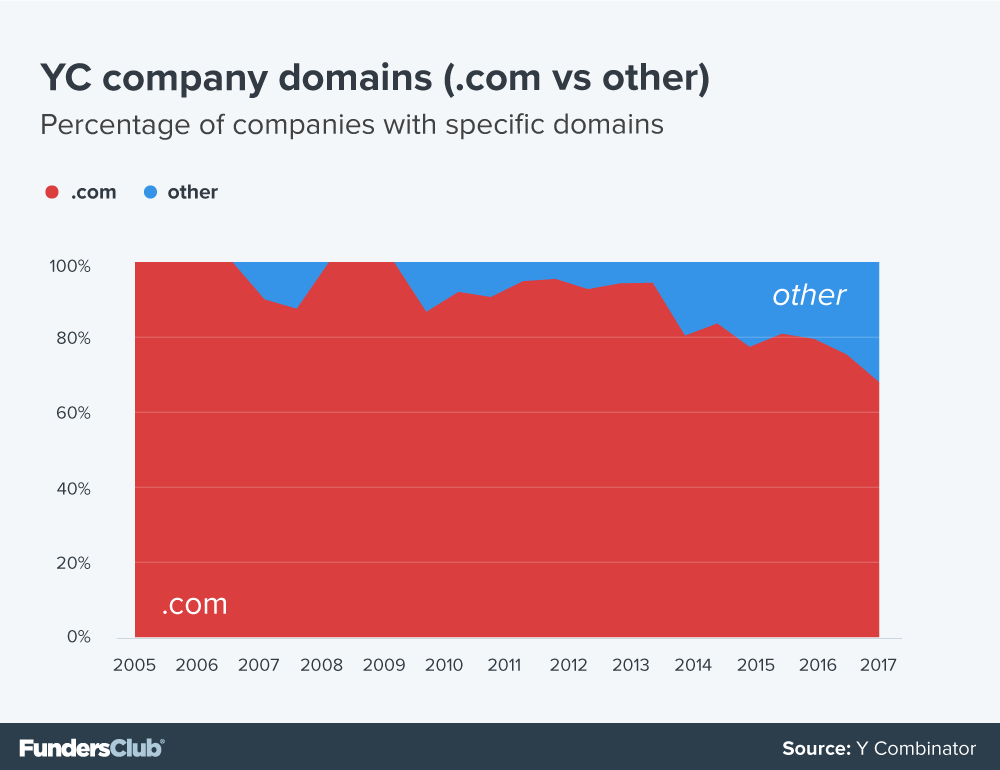
Most Startups Still Opt For Dot-Com Domains, But That’s Changing At Y Combinator.
Promising startups still end up with dot-com domains more often than not, but the margin at which they do is decreasing. (read more: fundersclub)
yc-1.png

line.png

series-a-2_H8s4ApM.png


Those are the stats, but the question remains: do startups need a dot-com domain?

"Startups don't need the dot-com domain right away—they can go out and buy it later if they're successful, says Michael Saunders, co-founder of BluePrint Alpha, an app that delivers users news and updates on companies, topics and stocks. Before Blueprint, Saunders founded Campusfood, which was acquired by Grubhub in 2011, and AllMenus, also acquired by Grubhub, which continues to be an SEO powerhouse for restaurant menu information.

Read more: fundersclub
 
4
•••
The views expressed on this page by users and staff are their own, not those of NamePros.
GoDaddyGoDaddy
interesting stats..

"Startups don't need the dot-com domain right away—they can go out and buy it later if they're successful"

but surely if someone doesn't secure that .com domain straight away its creating opportunity for someone else to come along and grab it before them.. its not a risk worth taking i feel

 
2
•••
as you can see if they do not go with .com they go with a short LL.ccTLD not .whatever
 
1
•••
"Startups don't need the dot-com domain right away—they can go out and buy it later if they're successful, says Michael Saunders, co-founder of BluePrint Alpha, an app that delivers users news and updates on companies, topics and stocks.
I am not so fond of this approach because:
  • if they start building a brand without owning the matching .com, the value of the .com could increase dramatically. In fact, there is no guarantee they will ever be able to buy the .com down the road.
    => My advice: secure your domain name at the beginning, even before you choose your brand/corporate name. First of all, get the domain name.
  • rebranding can be a painful experience
  • I don't agree that money is an issue: startups should have adequate funding, and there are plenty of good brandables available on the aftermarket for $$$$
  • A good .com adds a bit of credibility, that is not negligible when you are the new kid on the block
  • if you buy a strong name, it doesn't hurt, it simply shows that you are committed to your brand and you're in for the long haul
  • Last but not least: a good domain name is an asset that can be resold. Even if your venture doesn't succeed, you still have an asset.
 
7
•••
if they start building a brand without owning the matching .com, the value of the .com could increase dramatically.

This is where Domainers should step in and guard (or hold on) Startup related parcels until they manage to get the funds. Nothing wrong with that. If the Startup manage to get into the business arena, for them the price for .com is just "the another brick in the wall" (from our experience).
 
0
•••
they may not start with a .com - but they sure will want it if the business becomes a success.
 
0
•••
I've noticed a few UK businesses with uk.com names. They don't seem to realise they are registering a sub-domain.
 
0
•••
as you can see if they do not go with .com they go with a short LL.ccTLD not .whatever

You mean as YOU can see....

Fortunately, I am able to read and comprehend data properly... and what I see is about 4.5% of the 12.6% that are not going for the .com are going for non-ccTLD's... or what you call ".whatever"
 
0
•••
You mean as YOU can see....

Fortunately, I am able to read and comprehend data properly... and what I see is about 4.5% of the 12.6% that are not going for the .com are going for non-ccTLD's... or what you call ".whatever"

more than 2/3 that do not go with .com use a ccTLD.

if you look you see the 3.6% (other) are half ccTLDs .me, .tv, .org, .net... even among the alternatives .whatever are a minority. that is what I meant to say.
 
Last edited:
0
•••
more than 2/3 that do not go with .com use a ccTLD.

if you look you see the 3.6% (other) are half ccTLDs .me, .tv, .org, .net...

and what about the 0.8% going for .care? is that not a ".whatever" domain?

Also...org/net etc... are not ccTLD's. and .tv and .me are not really considered ccTLD's anymore
 
Last edited:
0
•••
and what about the 0.8% going for .care? is that not a ".whatever" domain?

Also...org/net etc... are not ccTLD's.

yes but not .whatever.

if you say 50% of other are .whatever 3.6/2= 1.8% + 0.8% (care) =2.6% .whatever.

The other alternatives have 10% combined. they are a minority in the minority.

Startups tend to avoid them even when they can not get a .com
 
Last edited:
0
•••
yes but not .whatever.

if you say 50% of other are .whatever 3.6/2= 1.8% + 0.8% (care) =2.6% .whatever.

The others alternatives have 10% combined. they are a minority in the minority.

So basically you are thumb sucking figures out your left nostril to conclude a 2.6% is .whatever? lol...

They have given us no indication of what the breakdown of the "other" is as a percentage. it could be 90% of the other is .whatever... .... ur 50% thumbsucked figure is about as credible or reliable as my 90% thumbsucked figure.
 
1
•••
Rebranding is not only painful, but expensive and a waste of money. Customers get confused, you loose credibility in the market and sometimes is done solely to appease ego's of management. I saw it first hand with a corp held by a larger one I worked for. Changing their name 5 times in 6 years to please exec's, believing M&A activities warranted it as it grew. In the end, went bankrupt. Like this recent news thing about Yahoo changing to Oath, it will cost big $$$ and changing your name does not help perception necessarily when a company isn't focused on customers and their product offerings are trailing in search and services, slow human interface and too front page ad's, etc.
 
0
•••
So basically you are thumb sucking figures out your left nostril to conclude a 2.6% is .whatever? lol...

They have given us no indication of what the split breakdown of the "other" is as a percentage. it could be 90% of the .other is .whatever... .... ur 50% thumbsucked figure is about as credible or reliable as my 90% thumbsucked figure.

even if you leave that out they are still a minority. I think as far as I remember, the real number was a low single digit percentage.

The trend is obviously going to short ccTLDs as alternatives.
 
0
•••
even if you leave that out they are still a minority. I think as far as I remember, the real number was a low single digit percentage.

The trend is obviously going to short ccTLDs as alternatives.

You are labelling .io / .co / .ai as normal ccTLD's when we both know that they are commonly used outside the cctld scope.. more so .IO and .AI they are used more as gTLD by start up tech companies.
 
0
•••
You are labelling .io / .co / .ai as normal ccTLD's when we both know that they are commonly used outside the cctld scope.. more so .IO and .AI they are used more as gTLD by start up tech companies.

yes but what I meant to say is that companies want short endings not long ones. Almost all are 3L or less.

.whatever is usually longer. The current trend is not going towards using longer words as domain endings.

In the past 25 years people got so used to using 2L ccTLDs and .com that even the alternatives have the same length or even very closely resemble .com (.co)
 
Last edited:
0
•••
would be interesting to get a breakdown of the startups focus in relation to the extension (at least the non .com's).

examples:

App vs website

global company vs locally driven

Web based vs Product driven
 
Last edited:
1
•••
Dynadot — .com TransferDynadot — .com Transfer
Appraise.net

We're social

Domain Recover
DomainEasy — Payment Flexibility
  • The sidebar remains visible by scrolling at a speed relative to the page’s height.
Back



