discuss Science & Technology news & discussion

SpaceshipSpaceship
Watch

CraigD

Top Member
Impact
11,745
Post and discuss interesting articles & videos about science and technology.

You don't need to be an expert - just interested in the wonders of modern science, technology, and the history of these fields.

Please keep it rational, and post articles from reputable sources.
Try not to editorialise headlines and keep the copy to just a paragraph with a link to the original source. When quoting excerpts from articles, I think the best method is to italicise the copy, and include a link to the source.

Have some fun with your comments and discussions... just keep the sources legitimate.

Other threads:
The Break Room has a number of other popular threads, so there is no need to post material here that is better suited to these other threads:

- Covid19-Coronavirus updates and news
- Conspiracy Thread Free For All
- The *religious* discussion thread


Please enjoy!
 
Last edited:
13
•••
The views expressed on this page by users and staff are their own, not those of NamePros.
GoDaddyGoDaddy
Artificial sweeteners may promote antibiotic resistance

Sweeteners%20antimicrobial%2020200225.jpg


Common artificial sweeteners such as saccharine and aspartame could speed up the spread of antibiotic resistance, according to University of Queensland research.

More than 117,000 tonnes of artificial sweeteners are consumed across the world each year and are accepted as safe food additives, but their effects on antibiotic resistance had been unknown.

Associate Professor Jianhua Guo, from UQ’s Advanced Water Management Centre, said scientists investigated if artificial sweeteners would encourage the transfer of antibiotic resistance genes between bacteria.


The research team tested four commonly consumed artificial sweeteners, including saccharine, sucralose, aspartame, and acesulfame potassium.

UQ PhD student Zhigang Yu said the sweeteners significantly accelerated the exchange of bacteria through a process known as conjugation.

https://www.uq.edu.au/news/article/2021/02/artificial-sweeteners-may-promote-antibiotic-resistance
 
3
•••
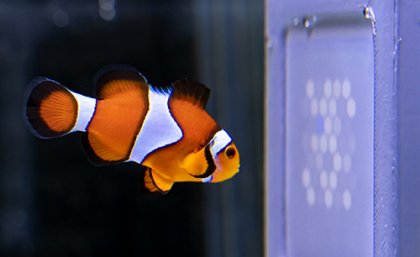
Ultraviolet ‘television’ for animals helps us better understand them

Science%20UV-TV%20TBA%20-%20BANNER%20SMALL.jpg


University of Queensland scientists have developed an ultraviolet ‘television’ display designed to help researchers better understand how animals see the world.

Until now, standard monitors on devices like televisions or computer screens have been used to display visual stimuli in animal vision studies, but none have been able to test ultraviolet vision – the ability to see wavelengths of light shorter than 400 nanometres.

Dr Samuel Powell from the Queensland Brain Institute's Marshall lab said this new technology will help unveil the secrets of sight in all sorts of animals, such as fish, birds and insects.

“Human TVs generally use three colours – red, green and blue – to create images, but our newly-developed displays have five, including violet and ultraviolet,” Dr Powell said.

“Using this display, it’s now possible to show animals simple shapes, to test their ability to tell colours apart, or their perception of motion by moving dot patterns.

https://www.uq.edu.au/news/article/...sion’-animals-helps-us-better-understand-them
 
2
•••
3
•••
Conspiracy theories start to take hold at age 14, study suggests

Conspiracy theories tend to prosper in times of crisis. When people are looking for ways to cope with uncertainty and threat, conspiracy theories may seem to offer simple answers. However, instead of making things better, conspiracy theories often make things worse.

Over the course of history, conspiracy theories have been linked to conflict, prejudice, genocide and the rejection of important scientific advances. Recently, belief in COVID-19 conspiracy theories (such as that the virus is a hoax) have been linked to vaccine rejection and reluctance to take action to stop the spread of the virus.


Using this questionnaire, we found that adolescents in the UK seem most likely to start believing in conspiracy theories around the age of 14. In one of our studies, we found that as adolescents reach around this age, their conspiracy beliefs were higher than in younger age groups. In another study, we found that 18-year-olds displayed higher belief in conspiracy theories compared to a mixed‐age sample of older adults. It therefore seems that adolescence could be a peak time for conspiracy theorising.

Between the ages of 11-14 and 14-16, belief in conspiracy theories increased from an average score of 3.72 to 4.67. Young people aged 16-17 also displayed a higher average (4.39) than the younger children. Furthermore, participants aged 18 reported higher conspiracy beliefs (4.06) than a mixed-age sample of older adults (3.81). Around the age of 14, conspiracy beliefs therefore appear to peak, and remain heightened into early adulthood, but then they appear to plateau.


Why conspiracy beliefs are taking hold

Many adolescents have been home schooled and isolated from their peer groups for much of the COVID-19 pandemic. It is therefore not surprising that their social media use has significantly increased during this time. This could be the ideal situation for conspiracy theories to flourish in younger groups.
 
3
•••
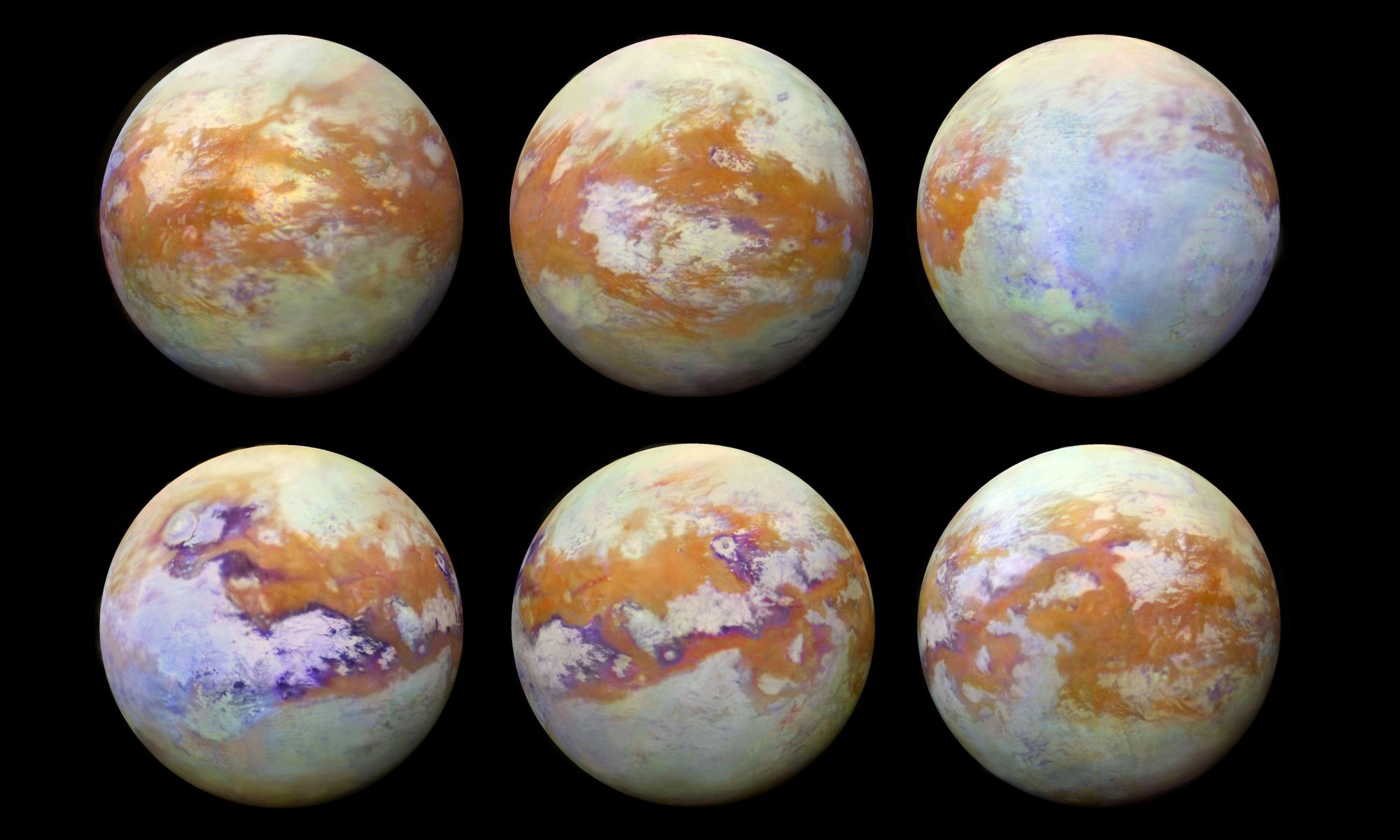
Titan’s Atmosphere Recreated in an Earth Laboratory

Beyond Earth, the general scientific consensus is that the best place to search for evidence of extraterrestrial life is Mars. However, it is by no means the only place. Aside from the many extrasolar planets that have been designated as “potentially-habitable,” there are plenty of other candidates right here in our Solar System. These include the many icy satellites that are thought to have interior oceans that could harbor life.

Seeing_Titan_with_infrared_eyes-2000x1200.jpg


Among them is Titan, Saturn’s largest moon that has all kinds of organic chemistry taking place between its atmosphere and surface. For some time, scientists have suspected that the study of Titan’s atmosphere could yield vital clues to the early stages of the evolution of life on Earth. Thanks to new research led by tech-giant IBM, a team of researchers has managed to recreate atmospheric conditions on Titan in a laboratory.


Their research is described in a paper titled “Imaging Titan’s Organic Haze at Atomic Scale,” which recently appeared in the Feb. 12th issue of The Astrophysical Journal Letters. The research team was led by Dr. Fabian Schulz and Dr. Julien Maillard and included many colleagues from IBM Research-Zurich, the University of Paris-Saclay, the University of Rouen at Mont-Saint-Aignan, and Fritz Haber Institute of the Max Planck Society.

What is particularly interesting is the fact that scientists believe that roughly 2.8 billion years ago, Earth’s atmosphere may have been similar. This coincides with the Mesoarchean Era, a period where photosynthetic cyanobacteria created the first reef systems and slowly converted Earth’s atmospheric carbon dioxide to oxygen gas (eventually leading to its current balance of nitrogen and oxygen).
 
3
•••
Light unbound: Data limits could vanish with new optical antennas

Researchers at the University of California, Berkeley, have found a new way to harness properties of light waves that can radically increase the amount of data they carry. They demonstrated the emission of discrete twisting laser beams from antennas made up of concentric rings roughly equal to the diameter of a human hair, small enough to be placed on computer chips.

oam-lasers-1360px.jpg


The new work, reported in a paper published Feb. 25 in the journal Nature Physics, throws wide open the amount of information that can be multiplexed, or simultaneously transmitted, by a coherent light source. A common example of multiplexing is the transmission of multiple telephone calls over a single wire, but there had been fundamental limits to the number of coherent twisted light waves that could be directly multiplexed.

“It’s the first time that lasers producing twisted light have been directly multiplexed,” said study principal investigator Boubacar Kanté, the Chenming Hu Associate Professor in UC Berkeley’s Department of Electrical Engineering and Computer Sciences. “We’ve been experiencing an explosion of data in our world, and the communication channels we have now will soon be insufficient for what we need. The technology we are reporting overcomes current data capacity limits through a characteristic of light called the orbital angular momentum. It is a game-changer with applications in biological imaging, quantum cryptography, high-capacity communications and sensors.”
 
3
•••
Conspiracy theories start to take hold at age 14, study suggests

Conspiracy theories tend to prosper in times of crisis. When people are looking for ways to cope with uncertainty and threat, conspiracy theories may seem to offer simple answers. However, instead of making things better, conspiracy theories often make things worse.

Over the course of history, conspiracy theories have been linked to conflict, prejudice, genocide and the rejection of important scientific advances. Recently, belief in COVID-19 conspiracy theories (such as that the virus is a hoax) have been linked to vaccine rejection and reluctance to take action to stop the spread of the virus.


Using this questionnaire, we found that adolescents in the UK seem most likely to start believing in conspiracy theories around the age of 14. In one of our studies, we found that as adolescents reach around this age, their conspiracy beliefs were higher than in younger age groups. In another study, we found that 18-year-olds displayed higher belief in conspiracy theories compared to a mixed‐age sample of older adults. It therefore seems that adolescence could be a peak time for conspiracy theorising.

Between the ages of 11-14 and 14-16, belief in conspiracy theories increased from an average score of 3.72 to 4.67. Young people aged 16-17 also displayed a higher average (4.39) than the younger children. Furthermore, participants aged 18 reported higher conspiracy beliefs (4.06) than a mixed-age sample of older adults (3.81). Around the age of 14, conspiracy beliefs therefore appear to peak, and remain heightened into early adulthood, but then they appear to plateau.


Why conspiracy beliefs are taking hold

Many adolescents have been home schooled and isolated from their peer groups for much of the COVID-19 pandemic. It is therefore not surprising that their social media use has significantly increased during this time. This could be the ideal situation for conspiracy theories to flourish in younger groups.

I think at the onset of puberty, young people begin formulating an internal framework of how and why the world works and their future within that world, but don't have the knowledge or experience to be able to evaluate and filter the bad information from the good.

Still, the good information is out there and not hard to find online.

Keep learning and eventually the internal framework of good sound knowledge should counteract the crazy theories.
 
Last edited:
4
•••
The Feynman Learning Technique is a great method to develop mastery over sets of information. But learning doesn’t happen in isolation. We learn not only from the books we read but also the people we talk to and the various positions, ideas, and opinions we are exposed to:

Step 1: Pretend to teach it to a child
Step 2: Identify gaps in your explanation
Step 3. Organize and simplify
Step 4: Transmit (optional)

To "know" things in a scientific sense, the first trick has to do with deciding whether someone else truly knows their stuff or is mimicking others. (I'm quoting, lol :xf.wink:)

The second trick has to do with dealing with uncertainty. Very few ideas in life are absolutely true. What you want is to get as close to the truth as you can with the information available. (Beware Fake news :cautious:)

Feynman’s third trick is the realization that as we investigate whether something is true or not, new evidence and new methods of experimentation should show the effect of getting stronger and stronger, not weaker.

The fourth trick is to ask the right question, which is not “Could this be the case?” but “Is this actually the case?” :xf.confused:

The fifth trick is you cannot judge the probability of something happening after it’s already happened. That’s cherry-picking. You have to run the experiment forward for it to mean anything.

The sixth trick is we must use proper statistical sampling to know whether or not we know what we’re talking about.

The last trick is to realize that many errors people make simply come from lack of information. They don’t even know they’re missing the tools they need. It’s hard to know when you’re missing information that would change your mind. :unsure:

https://fs.blog/2021/02/feynman-learning-technique/
 
4
•••
The Feynman Learning Technique is a great method to develop mastery over sets of information. But learning doesn’t happen in isolation. We learn not only from the books we read but also the people we talk to and the various positions, ideas, and opinions we are exposed to:

Step 1: Pretend to teach it to a child
Step 2: Identify gaps in your explanation
Step 3. Organize and simplify
Step 4: Transmit (optional)

To "know" things in a scientific sense, the first trick has to do with deciding whether someone else truly knows their stuff or is mimicking others. (I'm quoting, lol :xf.wink:)

The second trick has to do with dealing with uncertainty. Very few ideas in life are absolutely true. What you want is to get as close to the truth as you can with the information available. (Beware Fake news :cautious:)

Feynman’s third trick is the realization that as we investigate whether something is true or not, new evidence and new methods of experimentation should show the effect of getting stronger and stronger, not weaker.

The fourth trick is to ask the right question, which is not “Could this be the case?” but “Is this actually the case?” :xf.confused:

The fifth trick is you cannot judge the probability of something happening after it’s already happened. That’s cherry-picking. You have to run the experiment forward for it to mean anything.

The sixth trick is we must use proper statistical sampling to know whether or not we know what we’re talking about.

The last trick is to realize that many errors people make simply come from lack of information. They don’t even know they’re missing the tools they need. It’s hard to know when you’re missing information that would change your mind. :unsure:

https://fs.blog/2021/02/feynman-learning-technique/

Is this a technique that Richard Feynman actually taught, or an adaption of his concepts by a third party?

EDIT:

Richard had another saying that I always appreciated:
"The first principle is that you must not fool yourself, and you are the easiest person to fool."

Incidentally, I just came across his official site - run by the Estate of Richard Feynman.
http://www.richardfeynman.com/
 
Last edited:
2
•••
Is this a technique that Richard Feynman actually taught, or an adaption of his concepts by a third party?

I've simplified the main points, but from all accounts (besides the rubber ducky, lol) it's legit (y)
 
2
•••
Feynman on Chess (my favourite game) (y)

 
3
•••
1
•••
Nice!

I think Castling is akin to quantum entanglement or spooky action at a distance, but I'm still trying to think of a physical law that that mirrors En Passant.

I just came across this bizarre set of alternative chess rules based on physics:
https://www.chessvariants.com/other.dir/physics.html

You learn that move pretty quick the first time somebody plays it on you :xf.wink:

It's more like Divorce Law, lol
 
Last edited:
1
•••
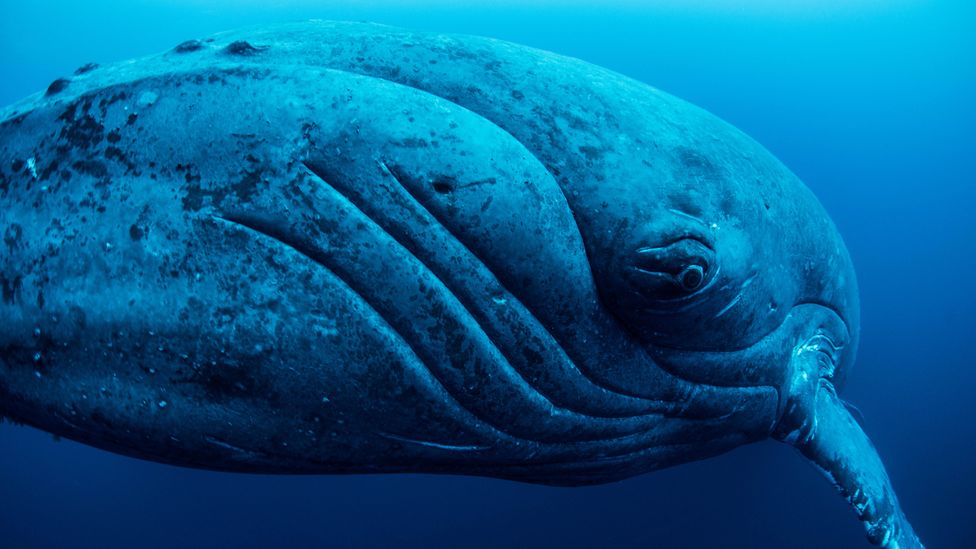
How whales help cool the Earth

The world's largest animals are unusually good at taking carbon dioxide out of the atmosphere.

p094frm2.jpg


Whales, particularly baleen and sperm whales, are among the largest creatures on Earth. Their bodies are enormous stores of carbon, and their presence in the ocean shapes the ecosystems around them.

From the depths of the ocean, these creatures are also helping to determine the temperature of the planet – and it's something that we've only recently started to appreciate.

When whales die, they sink to the ocean floor – and all the carbon that is stored in their enormous bodies is transferred from surface waters to the deep sea, where it remains for centuries or more.

In the 2010 study, scientists found that before industrial whaling, populations of whales (excluding sperm whales) would have sunk between 190,000 to 1.9 million tonnes of carbon per year to the bottom of the ocean – that's the equivalent of taking between 40,000 and 410,000 cars off the road each year. But when the carcass is prevented from sinking to the seabed – instead, the whale is killed and processed – that carbon is released into the atmosphere.
 
3
•••
How whales help cool the Earth

The world's largest animals are unusually good at taking carbon dioxide out of the atmosphere.

p094frm2.jpg


Whales, particularly baleen and sperm whales, are among the largest creatures on Earth. Their bodies are enormous stores of carbon, and their presence in the ocean shapes the ecosystems around them.

From the depths of the ocean, these creatures are also helping to determine the temperature of the planet – and it's something that we've only recently started to appreciate.

When whales die, they sink to the ocean floor – and all the carbon that is stored in their enormous bodies is transferred from surface waters to the deep sea, where it remains for centuries or more.

In the 2010 study, scientists found that before industrial whaling, populations of whales (excluding sperm whales) would have sunk between 190,000 to 1.9 million tonnes of carbon per year to the bottom of the ocean – that's the equivalent of taking between 40,000 and 410,000 cars off the road each year. But when the carcass is prevented from sinking to the seabed – instead, the whale is killed and processed – that carbon is released into the atmosphere.

I would have assumed that whale carcasses are largely consumed by other marine life, thus recycling the carbon back into the food chain.
 
3
•••
Hubble Spots Comet Near Jupiter


After traveling several billion miles toward the Sun, a wayward young comet-like object orbiting among the giant planets has found a temporary parking place along the way.

The object has settled near a family of captured ancient asteroids, called Trojans, that are orbiting the Sun alongside Jupiter. This is the first time a comet-like object has been spotted near the Trojan population.


Full story via NASA.gov: Comet Makes a Pit Stop Near Jupiter's Asteroids
 
3
•••
Mystery of Spinning Atomic Fragments Solved at Last

90DACA30-EF55-4DE2-BAB097E38F69A100_source.jpg


New experiments have answered the decades-old question of how pieces of splitting nuclei get their spins.

For more than 40 years, a subatomic mystery has puzzled scientists: Why do the fragments of splitting atomic nuclei emerge spinning from the wreckage? Now researchers find these perplexing gyrations might be explained by an effect akin to what happens when you snap a rubber band.

To get an idea why this whirling is baffling, imagine you have a tall stack of coins. It would be unsurprising if this unstable tower fell. However, after this stack collapsed, you likely would not expect all the coins to begin spinning as they hit the floor.

Much like a tall stack of coins, atomic nuclei rich in protons and neutrons are unstable. Instead of collapsing, such heavy nuclei are prone to splitting, a reaction known as nuclear fission. The resulting shards come out spinning, which can prove especially bewildering when the nuclei that split were not spinning themselves. Just as you would not expect an object to start moving on its own without some force acting on it, a body beginning to spin in absence of an initiating torque would seem decidedly supernatural, in apparent violation of the law of conservation of angular momentum.

This “makes it look like something was created from nothing,” says study lead author Jonathan Wilson, a nuclear physicist at Université Paris-Saclay's Irene Joliot-Curie Laboratory in Orsay, France. “Nature pulls a conjuring trick on us. We start with an object with no spin, and after splitting apart, both chunks are spinning. But, of course, angular momentum must still be conserved.”

Now Wilson and his colleagues have conclusively determined that this spinning results after the split, findings they detailed online February 24 in Nature. “This is wonderful new data,” says nuclear physicist George Bertsch at the University of Washington at Seattle, who did not participate in this study. “It’s really an important advance in our understanding of nuclear fission.”

https://www.scientificamerican.com/article/mystery-of-spinning-atomic-fragments-solved-at-last/
 
3
•••
Gulf Stream System at its weakest in over a millennium

In more than 1,000 years, the Atlantic Meridional Overturning Circulation (AMOC), also known as Gulf Stream System, has not been as weak as in recent decades. This is the result of a new study by scientists from Ireland, Britain and Germany. The researchers compiled so-called proxy data, taken mainly from natural archives like ocean sediments or ice cores, reaching back many hundreds of years to reconstruct the flow history of the AMOC. They found consistent evidence that its slowdown in the 20th century is unprecedented in the past millennium; it is likely linked to human-caused climate change. The giant ocean circulation system is relevant for weather patterns in Europe and regional sea levels in the U.S.; its slowdown is also associated with an observed cold blob in the northern Atlantic.

"The Gulf Stream System works like a giant conveyor belt, carrying warm surface water from the equator up north, and sending cold, low-salinity deep water back down south. It moves nearly 20 million cubic meters of water per second, almost 100 times the Amazon flow," explains Stefan Rahmstorf from the Potsdam Institute for Climate Impact Research PIK, initiator of the study to be published in Nature Geoscience. Previous studies by Rahmstorf and colleagues showed a slowdown of the ocean current of about 15% since the mid-20th century, linking it to human-caused global warming, but a robust picture about its long-term development has up to now been lacking: This is what the researchers provide with their review of results of proxy data studies.

"For the first time, we have combined a range of previous studies and found they provide a consistent picture of the AMOC evolution over the past 1600 years," says Rahmstorf. "The study results suggest that it has been relatively stable until the late 19th century. With the end of the little ice age in about 1850, the ocean currents began to decline, with a second, more drastic decline following since the mid-20th century." Already the 2019 special report on the oceans of the Intergovernmental Panel on Climate Change (IPCC) concluded with medium confidence "that the Atlantic Meridional Overturning Circulation (AMOC) has weakened relative to 1850-1900."

"The new study provides further independent evidence for this conclusion and puts it into a longer-term paleoclimatic context," Rahmstorf adds.

https://phys.org/news/2021-02-gulf-stream-weakest-millennium.html
 
5
•••
Parker Solar Probe Offers Stunning View of Venus

NASA’s Parker Solar Probe captured stunning views of Venus during its close flyby of the planet in July 2020.


wispr_venus_image.jpg


Though Parker Solar Probe’s focus is the Sun, Venus plays a critical role in the mission: The spacecraft whips by Venus a total of seven times over the course of its seven-year mission, using the planet’s gravity to bend the spacecraft’s orbit. These Venus gravity assists allow Parker Solar Probe to fly closer and closer to the Sun on its mission to study the dynamics of the solar wind close to its source.

But — along with the orbital dynamics — these passes can also yield some unique and even unexpected views of the inner solar system. During the mission’s third Venus gravity assist on July 11, 2020, the onboard Wide-field Imager for Parker Solar Probe, or WISPR, captured a striking image of the planet’s nightside from 7,693 miles away.

https://www.nasa.gov/feature/goddard/2021/parker-solar-probe-offers-a-stunning-view-of-venus
 
3
•••
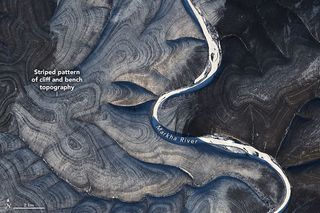
Mysterious stripes spotted over Russia in satellite images — and NASA is perplexed

Dv5XDUcgxsvm74TtjwyqBb-320-80.jpg


Near the Markha River in Arctic Siberia, the earth ripples in ways that scientists don't fully understand.


Earlier this week, NASA researchers posted a series of satellite images of the peculiar wrinkled landscape to the agency's Earth Observatory website. Taken with the Landsat 8 satellite over several years, the photos show the land on both sides of the Markha River rippling with alternating dark and light stripes. The puzzling effect is visible in all four seasons, but it is most pronounced in winter, when white snow makes the contrasting pattern even more stark.


One possible explanation is written in the icy ground. This region of the Central Siberian Plateau spends about 90% of the year covered in permafrost, according to NASA, though it occasionally thaws for brief intervals. Patches of land that continuously freeze, thaw and freeze again have been known to take on strange circular or stripy designs called patterned ground, scientists reported in a study published in January 2003 in the journal Science. The effect occurs when soils and stones naturally sort themselves during the freeze-thaw cycle.


3
•••
Appraise.net

We're social

Spaceship
Domain Recover
CatchDoms
DomainEasy — Zero Commission
  • The sidebar remains visible by scrolling at a speed relative to the page’s height.
Back