discuss Science & Technology news & discussion

NamecheapNamecheap
Watch

CraigD

Top Member
Impact
11,745
Post and discuss interesting articles & videos about science and technology.

You don't need to be an expert - just interested in the wonders of modern science, technology, and the history of these fields.

Please keep it rational, and post articles from reputable sources.
Try not to editorialise headlines and keep the copy to just a paragraph with a link to the original source. When quoting excerpts from articles, I think the best method is to italicise the copy, and include a link to the source.

Have some fun with your comments and discussions... just keep the sources legitimate.

Other threads:
The Break Room has a number of other popular threads, so there is no need to post material here that is better suited to these other threads:

- Covid19-Coronavirus updates and news
- Conspiracy Thread Free For All
- The *religious* discussion thread


Please enjoy!
 
Last edited:
13
•••
The views expressed on this page by users and staff are their own, not those of NamePros.
GoDaddyGoDaddy
Asteroid dust found in crater closes case of dinosaur extinction

https://phys.org/news/2021-02-asteroid-crater-case-dinosaur-extinction.html

"Researchers believe they have closed the case of what killed the dinosaurs, definitively linking their extinction with an asteroid that slammed into Earth 66 million years ago by finding a key piece of evidence: asteroid dust inside the impact crater.

Death by asteroid rather than by a series of volcanic eruptions or some other global calamity has been the leading hypothesis since the 1980s, when scientists found asteroid dust in the geologic layer that marks the extinction of the dinosaurs. This discovery painted an apocalyptic picture of dust from the vaporized asteroid and rocks from impact circling the planet, blocking out the sun and bringing about mass death through a dark, sustained global winter—all before drifting back to Earth to form the layer enriched in asteroid material that's visible today."

Interesting.

https://www.livescience.com/dinosaur-killing-comet-oort-cloud.html

They propose it was a comet pulled in by Jupiter's gravity.
 
3
•••
Still waiting for the day when one of those ultra-fast "long cylindrical objects" and "UFOs" stops and takes the time to say "Hi". At least after such a long travel from outer planets or even galaxies, they deserve to shake hands and take a drink! :xf.grin:

Now seriously, about the strange encounter, it's good to point out this: "That being said, we need to point out that the Mount Dora Military Operating Area (MOA) is in that area".

It's entirely feasible that this could have been a privately manufactured vehicle.

I posted an article a few days ago about a prototype flying car straying 8000ft up into the airspace at Gatwick airport after the designers lost control of it.

We are going to witness more of these 'close encounters' as rocket and jet technology becomes more readily available to the public.
 
Last edited:
4
•••
New study suggests supermassive black holes could form from dark matter

https://phys.org/news/2021-02-supermassive-black-holes-dark.html

"A new theoretical study has proposed a novel mechanism for the creation of supermassive black holes from dark matter. The international team find that rather than the conventional formation scenarios involving 'normal' matter, supermassive black holes could instead form directly from dark matter in high density regions in the centers of galaxies. The result has key implications for cosmology in the early Universe, and is published in Monthly Notices of the Royal Astronomical Society.

Standard formation models involve normal baryonic matter—the atoms and elements that that make up stars, planets, and all visible objects—collapsing under gravity to form black holes, which then grow over time. However the new work investigates the potential existence of stable galactic cores made of dark matter, and surrounded by a diluted dark matter halo, finding that the centers of these structures could become so concentrated that they could also collapse into supermassive black holes once a critical threshold is reached."
 
Last edited:
3
•••
Earliest human ancestors may have swung on branches like chimps


Our distant ancestors may have swung from branches and knuckle-walked like a chimpanzee – challenging recent thinking that the earliest hominins did neither. That is the conclusion of an analysis of 4.4-million-year-old Ardipithecus ramidus, thought to be one of the earliest known hominins.

In popular thinking, humans are often imagined to have evolved from a chimpanzee-like ape, but many researchers now challenge this idea – particularly in light of fossil evidence from A. ramidus that was published in 2009. One well-preserved individual – nicknamed Ardi – had bones that suggested it typically walked along branches like a monkey rather than swinging below them like a chimp. This hinted that our last common ancestor with chimps also walked along branches, and that chimps evolved to swing and knuckle-walk after they branched off from hominins.

2cf85dn_web.jpg


Thomas C. Prang at Texas A&M University and his colleagues disagree with this conclusion. They have taken the measurements of Ardi’s hands reported in 2009 and compared them with 416 measurements from hands across 53 species of living primates, including chimpanzees, bonobos and humans.

The analysis of this hand, one of the earliest hands in the human fossil record, suggests that it is chimpanzee-like, implying that both humans and chimps evolved from an ancestor that was chimp-like,” says Prang.
 
Last edited:
3
•••
Last edited:
4
•••
Interesting.

https://www.livescience.com/dinosaur-killing-comet-oort-cloud.html

They propose it was a comet pulled in by Jupiter's gravity.
In two decades, it triggered the extinction of 75% of life on Earth... what a slam!

"The dust is all that remains of the 7-mile-wide asteroid that slammed into the planet millions of years ago, triggering the extinction of 75% of life on Earth, including all nonavian dinosaurs

Researchers estimate that the dust kicked up by the impact circulated in the atmosphere for no more than a couple of decades—which, Gulick points out, helps time how long extinction took.

"If you're actually going to put a clock on extinction 66 million years ago, you could easily make an argument that it all happened within a couple of decades, which is basically how long it takes for everything to starve to death," he said.
 
2
•••
In two decades, it triggered the extinction of 75% of life on Earth... what a slam!

"The dust is all that remains of the 7-mile-wide asteroid that slammed into the planet millions of years ago, triggering the extinction of 75% of life on Earth, including all nonavian dinosaurs

Researchers estimate that the dust kicked up by the impact circulated in the atmosphere for no more than a couple of decades—which, Gulick points out, helps time how long extinction took.

"If you're actually going to put a clock on extinction 66 million years ago, you could easily make an argument that it all happened within a couple of decades, which is basically how long it takes for everything to starve to death," he said.

Yes, on a much smaller scale humanity witnessed the eruption of Krakatoa causing crops to fail in Europe during the aptly named Dark Ages. That comparatively small eruption caused untold devastation. Now times that by a thousand...
 
2
•••
Scientists begin building highly accurate digital twin of our planet

A digital twin of our planet is to simulate the Earth system in future. It is intended to support policy-makers in taking appropriate measures to better prepare for extreme events. A new strategy paper by European scientists and ETH Zurich computer scientists shows how this can be achieved.


image.imageformat.fullwidth.2062592557.jpg


To become climate neutral by 2050, the European Union launched two ambitious programmes: "Green Deal" and "DigitalStrategy". As a key component of their successful implementation, climate scientists and computer scientists launched the "Destination Earth" initiative, which will start in mid-2021 and is expected to run for up to ten years. During this period, a highly accurate digital model of the Earth is to be created, a digital twin of the Earth, to map climate development and extreme events as accurately as possible in space and time.

Observational data will be continuously incorporated into the digital twin in order to make the digital Earth model more accurate for monitoring the evolution and predict possible future trajectories. But in addition to the observation data conventionally used for weather and climate simulations, the researchers also want to integrate new data on relevant human activities into the model. The new "Earth system model" will represent virtually all processes on the Earth's surface as realistically as possible, including the influence of humans on water, food and energy management, and the processes in the physical Earth system.
 
3
•••
Ancient art reveals extinct goose
Science%20Geese%20LOwres_Romilio_2021_1.jpg


As a University of Queensland researcher examined a 4600-year-old Egyptian painting last year, a speckled goose caught his eye.

UQ scientist Dr Anthony Romilio said the strange but beautiful bird was quite unlike modern red-breasted geese (Branta ruficollis), with distinct, bold colours and patterns on its body, face, breast, wings and legs.

“The painting, Meidum Geese, has been admired since its discovery in the 1800s and described as ‘Egypt’s Mona Lisa’,” he said.


Dr Romilio said the artwork he examined was from the tomb of Nefermaat and Itet at Meidum and was now in Cairo’s Museum of Egyptian Antiquities.

“Art provides cultural insight, but also a valuable, graphical record of animals unknown today,” he said.
 
2
•••
Exercise generates immune cells in bone

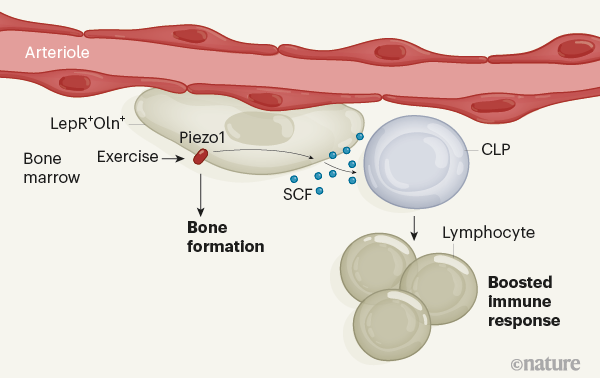
A specialized type of bone-cell progenitor has been identified in the bone marrow, and shown to support the generation of immune cells called lymphocytes in response to movement.

It is pretty crowded in the bone marrow. Many types of stem and progenitor cell, including progenitors of immune cells, coexist side-by-side1,2 and are supported by nearby cells that generate specialized protective environments for the stem cells, called niches. The interplay between the cells of the niche, also known as stromal cells, and early progenitors of immune cells in the bone marrow is poorly understood. Insight into how this interplay is coordinated would help us to better understand how progenitors of immune cells are generated. Writing in Nature, Shen et al.3 have solved part of the puzzle by identifying a role for movement in stimulating communication between one type of stromal cell and immune progenitors in mice, ultimately helping the animals to fight infection.

d41586-021-00419-y_18880566.png
 
2
•••
Powerful X-Rays Reveal Unique Differences in Neurons From People With Schizophrenia

schizophrenia_wavy_cells_1024.jpg


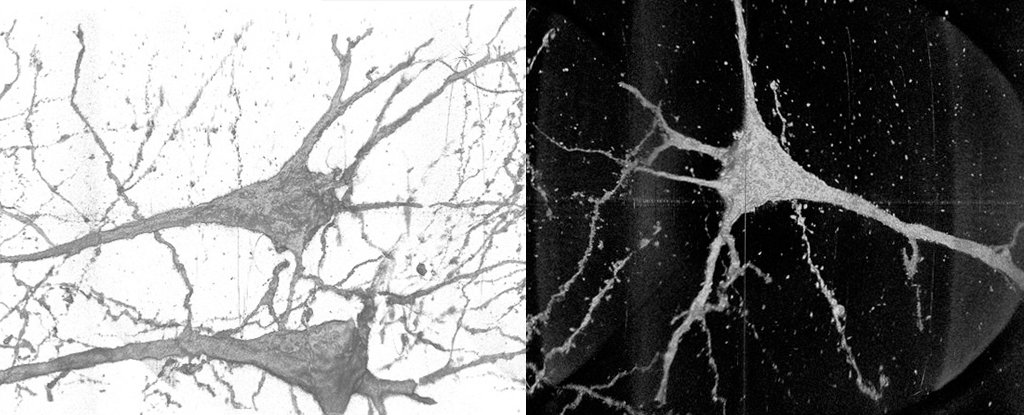
Capturing details of brain cells on a nanometre scale, researchers have uncovered evidence that the neurons of people with schizophrenia could have unique differences in thickness and curvature, and this might even account for some of their symptoms.

The finding comes from an analysis on just a small handful of donors, and is a long way from demonstrating how contrasting nerve cell structures might explain the neurological condition.

But as our understanding of these unusual characteristics grows, it could lead to better methods of treatment, helping give tens of millions around the world a better quality of life.

The study, led by researchers from Tokai University in Japan, made use of two different X-ray microscope technologies, one at the SPring-8 light source facility in Japan, the other at the US Department of Energy's Advanced Photon Source (APS).

https://www.sciencealert.com/powerf...tures-unique-details-of-schizophrenia-neurons
 
2
•••
Last edited:
3
•••
Rare bird: 'Half-male, half-female' cardinal snapped in Pennsylvania

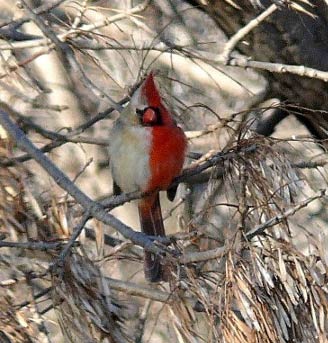
A bird that appears to be half-female and half-male has been photographed in Pennsylvania by a birder who rushed out with his camera when he heard a friend had spotted the northern cardinal.

_117215349_cardinal5.jpg


Though not unheard of, mixed sex birds are rare.

Male cardinals are bright red but females are pale brown, suggesting this specimen may be a mix of the two sexes.

Retired ornithologist Jamie Hill, 69, told the BBC it was a "once-in-a-lifetime, one-in-a-million encounter".

 
3
•••
Rare bird: 'Half-male, half-female' cardinal snapped in Pennsylvania

A bird that appears to be half-female and half-male has been photographed in Pennsylvania by a birder who rushed out with his camera when he heard a friend had spotted the northern cardinal.

_117215349_cardinal5.jpg


Though not unheard of, mixed sex birds are rare.

Male cardinals are bright red but females are pale brown, suggesting this specimen may be a mix of the two sexes.

Retired ornithologist Jamie Hill, 69, told the BBC it was a "once-in-a-lifetime, one-in-a-million encounter".

I was very intrigued by this picture so did a quick bit of research. They are known as 'half-siders'. I found an old picture of what appears to be the same species but with colours reversed!

Half-sider-Cardinal.jpg


Explanation on how this occurs in the following article:
https://lafeber.com/pet-birds/a-unique-feather-color-mutation/
 
Last edited:
2
•••
A Major Ocean Current Could Be on The Verge of a Devastating 'Tipping Point'

small-cartoon-strip.jpg


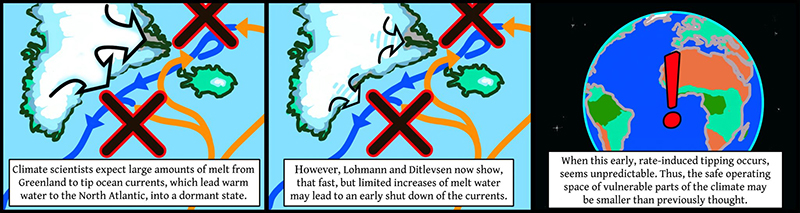
The Atlantic Meridional Overturning Circulation (AMOC) sea currents are vital in transporting heat from the tropics to the Northern Hemisphere, but new research suggests climate change might knock the AMOC out of action much sooner than we anticipated.

That could have profound, large-scale impacts on the planet in terms of weather patterns, upending agricultural practices, biodiversity, and economic stability across the vast areas of the world that the AMOC influences.

The problem is the rate at which Earth is warming up and melting the ice in the Arctic: according to the researchers' new models, this speed of temperature increase means the risk of hitting the tipping point for the AMOC going dormant is now an urgent concern.

"It is worrying news," says physicist Johannes Lohmann, from the University of Copenhagen in Denmark. "Because if this is true, it reduces our safe operating space."

Lohmann and his colleague Peter Ditlevsen adapted an existing ocean climate change model to study the consequences of an increased rate of freshwater input into the North Atlantic Ocean, driven by the rapid melting of the Greenland ice sheets.

The model showed that a faster rate of freshwater change could cancel out the AMOC much sooner. In a rate-induced tipping scenario like this, it's the rate at which change is occurring, rather than a specific threshold, that's most important – and once the tipping point is reached, there's no going back.

https://www.sciencealert.com/a-majo...n-the-verge-of-a-climate-change-tipping-point
 
4
•••
A Major Ocean Current Could Be on The Verge of a Devastating 'Tipping Point'

small-cartoon-strip.jpg


The Atlantic Meridional Overturning Circulation (AMOC) sea currents are vital in transporting heat from the tropics to the Northern Hemisphere, but new research suggests climate change might knock the AMOC out of action much sooner than we anticipated.

That could have profound, large-scale impacts on the planet in terms of weather patterns, upending agricultural practices, biodiversity, and economic stability across the vast areas of the world that the AMOC influences.

The problem is the rate at which Earth is warming up and melting the ice in the Arctic: according to the researchers' new models, this speed of temperature increase means the risk of hitting the tipping point for the AMOC going dormant is now an urgent concern.

"It is worrying news," says physicist Johannes Lohmann, from the University of Copenhagen in Denmark. "Because if this is true, it reduces our safe operating space."

Lohmann and his colleague Peter Ditlevsen adapted an existing ocean climate change model to study the consequences of an increased rate of freshwater input into the North Atlantic Ocean, driven by the rapid melting of the Greenland ice sheets.

The model showed that a faster rate of freshwater change could cancel out the AMOC much sooner. In a rate-induced tipping scenario like this, it's the rate at which change is occurring, rather than a specific threshold, that's most important – and once the tipping point is reached, there's no going back.

https://www.sciencealert.com/a-majo...n-the-verge-of-a-climate-change-tipping-point

This article made me think of a book I read 30-years ago titled Stark, by Ben Elton.
https://en.wikipedia.org/wiki/Stark_(novel)

It wasn't that well written being his first published novel after he worked on The Young Ones and Black Adder, but the premise was intriguing in that the Earth went down hill very very quickly after the tipping point was reached.

There were also some very rich billionaires who were building space arks to save themselves and the select few.

It was all sci-fi fantasy 30-years ago, but it has just hit me how seriously prophetic that book was!


EDIT: I've just found an interesting article from 2020 - a rereading Ben Elton’s Stark as prophecy:

https://theconversation.com/the-ear...rereading-ben-eltons-stark-as-prophecy-147256
 
Last edited:
4
•••
Researchers capture how materials break apart following an extreme shock

11-researchersc.jpg


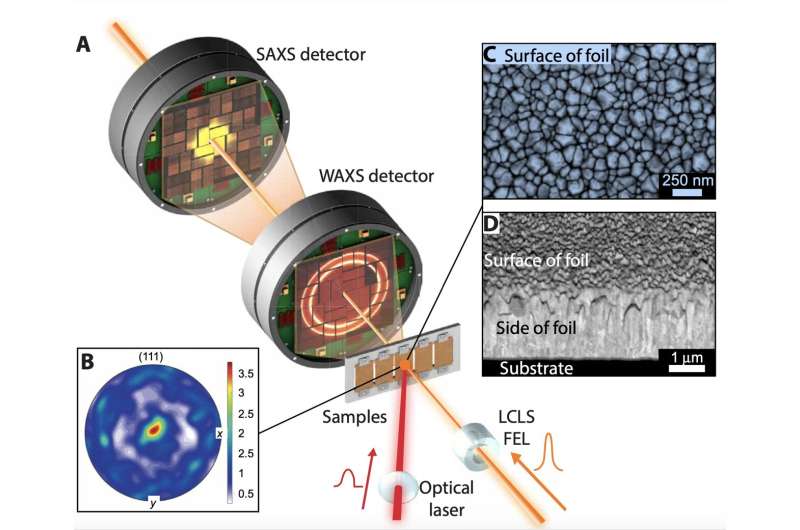
Understanding how materials deform and catastrophically fail when impacted by a powerful shock is crucial in a wide range of fields, including astrophysics, materials science and aerospace engineering. But until recently, the role of voids, or tiny pores, in such a rapid process could not be determined, requiring measurements to be taken at millionths of a billionth of a second.

Now an international research team has used ultrabright X-rays to make the first observations of how these voids evolve and contribute to damage in copper following impact by an extreme shock. The team, including scientists from the University of Miami, the Department of Energy's SLAC National Accelerator Laboratory and Argonne National Laboratory, Imperial College London and the universities of Oxford and York published their results in Science Advances.

"Whether these materials are in a satellite hit by a micrometeorite, a spacecraft entering the atmosphere at hypersonic speed or a jet engine exploding, they have to fully absorb all that energy without catastrophically failing," says lead author James Coakley, an assistant professor of mechanical and aerospace engineering at the University of Miami. "We're trying to understand what happens in a material during this type of extremely rapid failure. This experiment is the first round of attempting to do that, by looking at how the material compresses and expands during deformation before it eventually breaks apart."

https://phys.org/news/2021-02-capture-materials-extreme.html
 
2
•••
A prototype of an intelligent underground robotic system for urban environments

6037b0e9e0a51.jpg


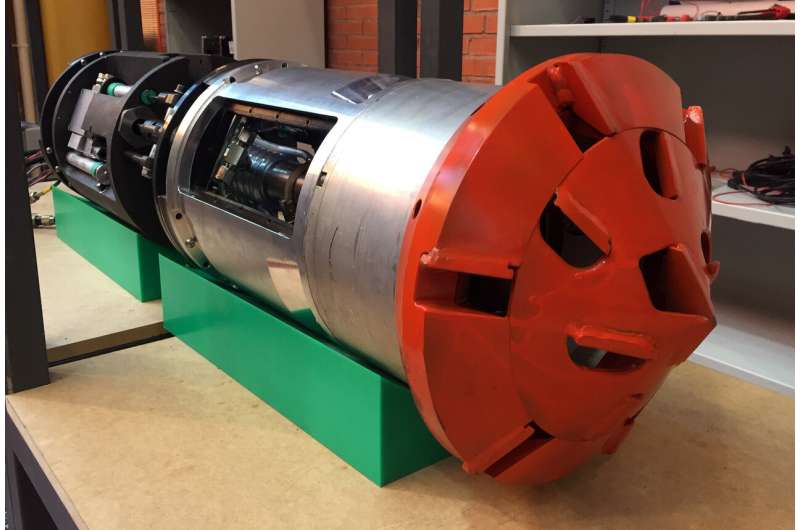
The European research project BADGER, coordinated by the Universidad Carlos III de Madrid (UC3M), has presented a prototype of an autonomous underground robot with intelligent navigation for urban environments.

This robotic system is composed of two main elements: a surface vehicle with a geo-radar that is used to scan the ground, so that subterranean obstacles can be detected; and an autonomous underground robot that does the drilling work. "Once the subsoil has been scanned by the rover, using a software developed as part of the project, a work plan is drawn up and an entry and exit point for the work to be carried out is established. The next task consists of taking the robot to the place where the work will be carried out and using it to drill from one point to another," explains the BADGER project's technical manager, Santiago Martínez de la Casa, researcher at the RoboticsLab in the UC3M's Department of Systems Engineering and Automation.


https://techxplore.com/news/2021-02-prototype-intelligent-underground-robotic-urban.html
 
3
•••
Airliner Encountered Unidentified Fast-Moving Cylindrical Object Over New Mexico

American Airlines Flight 2292, an Airbus A320 flying between Cincinnati and Phoenix on February 21st, 2021, had a bizarre close encounter with what its crew described as a "long cylindrical object that almost looked like a cruise missile" moving extremely fast over the top of their aircraft as it cruised along at 36,000 feet and 400 knots. The incident occurred over the remote northeast corner of New Mexico, to the west of the tiny town of
Des Moines.

https://www.thedrive.com/the-war-zo...ast-moving-cylindrical-object-over-new-mexico


Make of this what you will, but the most obvious explanation is the most likely, and that is that it WAS a missile of sorts. It's New Mexico after all, home to USAF testing.

More on that UFO encounter over New Mexico on Feb 21 2021.

https://www.popularmechanics.com/mi...ect-ufo-spotted-over-new-mexico-fbi-confirms/

 
1
•••
Successful engine test brings Australian space launch capability a step closer

successfulen.jpg


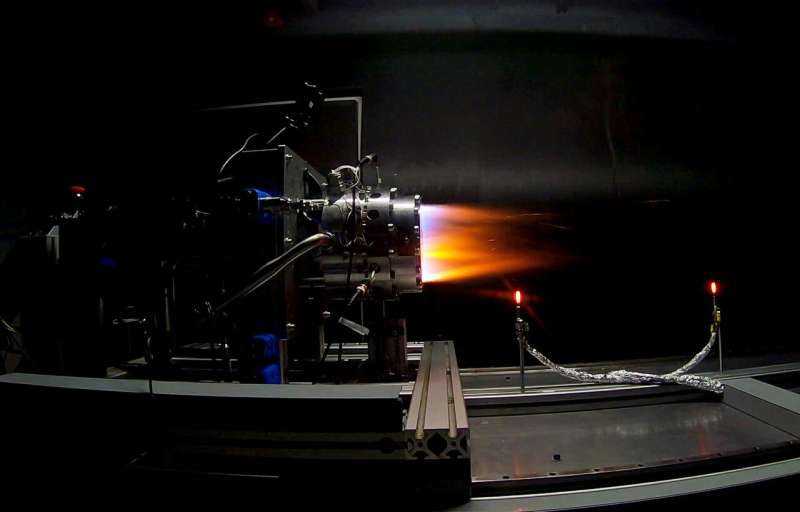
An Australian research consortium has successfully tested a next generation propulsion system that could enable high-speed flight and space launch services.

While conventional rocket engines operate by burning fuel at constant pressure, RDEs produce thrust by rapidly detonating their propellant in a ring-shaped combustor. Once started, the engine is in a self-sustaining cycle of detonation waves that travel around the combustor at supersonic speeds greater than 2.5km a second.

Using this type of combustion has the potential to significantly increase engine efficiency and performance, with applications in rocket propulsion and high-speed airbreathing engines—similar to ramjets.

Benefits over existing engines include better fuel efficiency, simpler flight systems and a more compact engine, allowing for larger payloads and reduced launch costs.

https://phys.org/news/2021-02-successful-australian-space-capability-closer.html
 
2
•••
Dynadot — .com TransferDynadot — .com Transfer

We're social

Spaceship
Domain Recover
CatchDoms
DomainEasy — Payment Flexibility
  • The sidebar remains visible by scrolling at a speed relative to the page’s height.
Back