Dynadot โ€” .com Transfer

discuss Science & Technology news & discussion

Spacemail by SpaceshipSpacemail by Spaceship
Watch

CraigD

Top Member
Impact
11,745
Post and discuss interesting articles & videos about science and technology.

You don't need to be an expert - just interested in the wonders of modern science, technology, and the history of these fields.

Please keep it rational, and post articles from reputable sources.
Try not to editorialise headlines and keep the copy to just a paragraph with a link to the original source. When quoting excerpts from articles, I think the best method is to italicise the copy, and include a link to the source.

Have some fun with your comments and discussions... just keep the sources legitimate.

Other threads:
The Break Room has a number of other popular threads, so there is no need to post material here that is better suited to these other threads:

- Covid19-Coronavirus updates and news
- Conspiracy Thread Free For All
- The *religious* discussion thread


Please enjoy!
 
Last edited:
13
•••
The views expressed on this page by users and staff are their own, not those of NamePros.
.US domains.US domains
Largest canyon in the solar system revealed in stunning new images

It's nearly 10 times as long as the Grand Canyon, and three times as deep. But how did it form?

yYCSkAyRmEyL4jhtnpuvS7-320-80.jpg


About 87 million miles (140 million kilometers) above the Grand Canyon, an even larger, grander abyss cuts through the gut of the Red Planet. Known as Valles Marineris, this system of deep, vast canyons runs more than 2,500 miles (4,000 km) along the Martian equator, spanning nearly a quarter of the planet's circumference. This gash in the bedrock of Mars is nearly 10 times as long as Earth's Grand Canyon and three times deeper, making it the single largest canyon in the solar system โ€” and, according to ongoing research from the University of Arizona (UA) in Tucson, one of the most mysterious.


ESP_034132_1750.jpg


https://www.uahirise.org/hipod/ESP_034132_1750
 
4
•••
Synchronized violin players reveal uniqueness of human networks

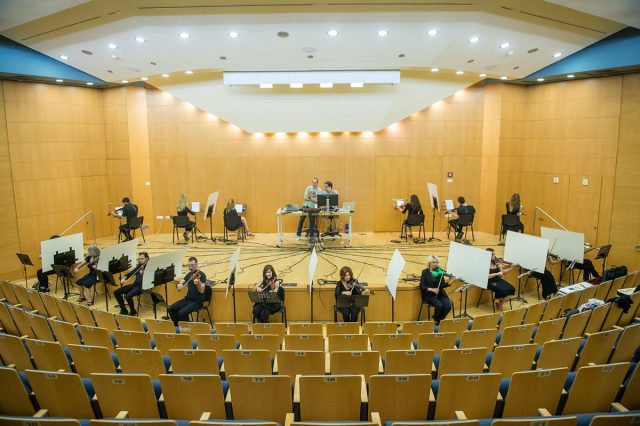
An unusual experiment involving 16 violinists trying to synchronize their playing while wearing noise-canceling headphones yielded some intriguing results, according to an August 2020 paper published in Nature Communications. The study concluded that human networks are fundamentally different from other networks in terms of synchronized behavior because of our decision-making ability. That could lead to better models for complex human behavior, with applications in such diverse areas as economics, epidemiology, politics, traffic management, and the spread of misinformation.

violsynchTOP-640x426.jpg


The participating violinists donned noise-canceling headphones and began playing the same musical phrase on repeat, without looking at or listening to the other players. They could only rely on what they heard through the headphones, which were connected to a computer system. The researchers then introduced intermittent delays in signals between coupled violinists, varying the delays and the combinations of violinists. It's called a "frustrated situation," and most network models assume that in such a frustrated state, each node will attempt to find a middle ground between all the various inputs.

Instead, Fridman et al. found that the players reacted by adjusting their playing, quickening or slowing their tempo to better synchronize with their fellow violinists. "Human networks behave differently than any other network we've ever measured," Fridman told The Jerusalem Post. "In a state of frustration, they don't look for a 'middle,' but ignore one of the inputs. This is a critical phenomenon that is changing the dynamics of the network. Human networks are able to change their inner structure in order to reach a better solution than what's possible in existing models."

Video.

 
3
•••
Surprising news: Drylands are not getting drier

A new study shows the importance of long-term soil moisture changes and associated soil moisture-atmosphere feedbacks in future predictions of water availability in drylands. The researchers identified a long-term soil moisture regulation of atmospheric circulation and moisture transport that largely ameliorates the potential decline of future water availability in drylands, beyond that expected in the absence of soil moisture feedbacks.
 
2
•••
3
•••
Five asteroids are set to fly past the planet tomorrow โ€” two of them are bigger than the Eiffel Tower

  • Five asteroids are set to make a close approach to Earth tomorrow, on January 6.
  • Two of the asteroids โ€” 2016 CO247 and 2008 AF4 โ€” are bigger than the Eiffel Tower.
  • Even the smallest of the five asteroids, 2021 AJ, is travelling fast enough to release as much energy as the Hiroshima bomb blast if it were to crash into the planet.
Asteroids that will make a close approach to Earth on January 6:
Asteroid Time (GMT) Average diameter Speed (kilometres per hour)
2021 AC 03:27 73.5 metres 50,652 kmph
2016 CO247 04:09 340 metres 60,228 kmph
2021 AJ 11:38 19.5 metres 45,648 kmph
2018 KP1 13:21 41 metres 15,948 kmph
332446 (2008 AF4) 21:52 495 metres 39,564 kmph
 
3
•••
Five asteroids are set to fly past the planet tomorrow โ€” two of them are bigger than the Eiffel Tower

  • Five asteroids are set to make a close approach to Earth tomorrow, on January 6.
  • Two of the asteroids โ€” 2016 CO247 and 2008 AF4 โ€” are bigger than the Eiffel Tower.
  • Even the smallest of the five asteroids, 2021 AJ, is travelling fast enough to release as much energy as the Hiroshima bomb blast if it were to crash into the planet.
Asteroids that will make a close approach to Earth on January 6:
Asteroid Time (GMT) Average diameter Speed (kilometres per hour)
2021 AC 03:27 73.5 metres 50,652 kmph
2016 CO247 04:09 340 metres 60,228 kmph
2021 AJ 11:38 19.5 metres 45,648 kmph
2018 KP1 13:21 41 metres 15,948 kmph
332446 (2008 AF4) 21:52 495 metres 39,564 kmph
I think the first four-digits of the assigned name refers to the year they were first catalogued(?)
 
3
•••
Chemical Analysis of a Black Spot in a Diary Sheds New Light on Legendary Polar Explorerโ€™s Final Hours

Denmark-Expedition-Sledteam-1.jpg


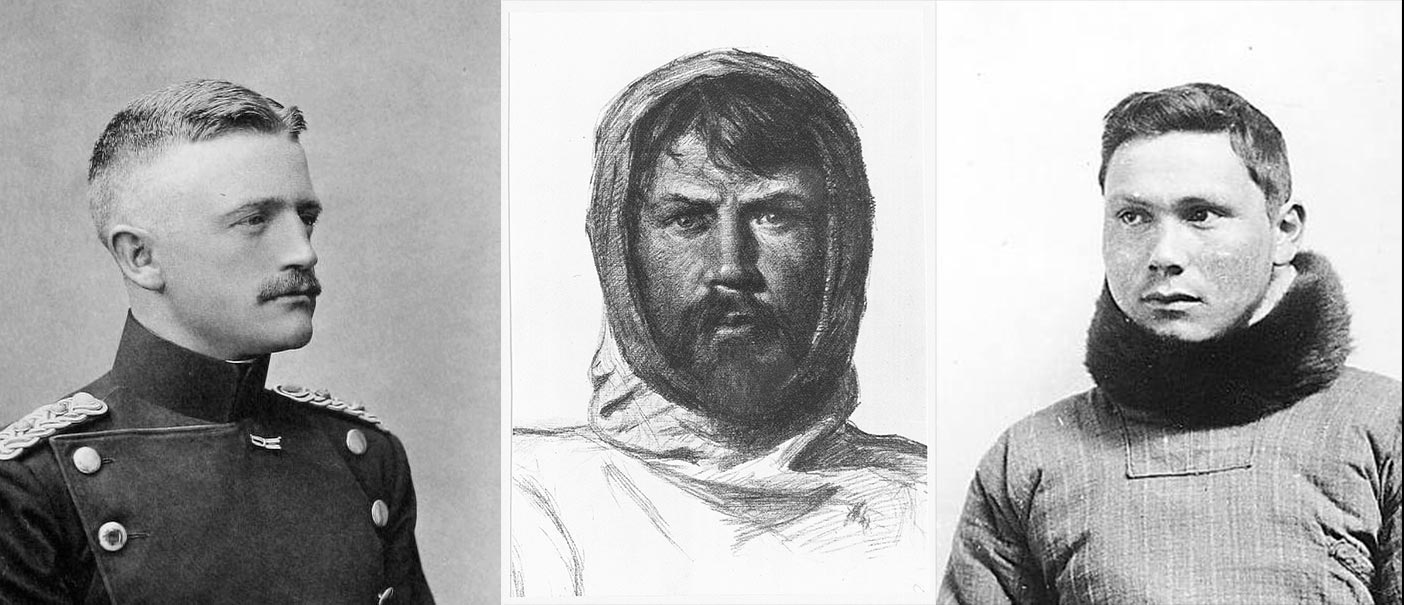
The Denmark Expedition set out to explore unknown Inuit land in 1906. Three members died.

Chemical analysis of a black spot in a diary sheds new light on the destiny and tragic death of legendary Inuit polar expedition member Jรธrgen Brรธnlund in Northeast Greenland in 1907.

https://scitechdaily.com/chemical-a...ght-on-legendary-polar-explorers-final-hours/
 
3
•••
Rutgers engineersโ€™ invention can become color-changing โ€˜artificial muscleโ€™

Inspired by the color-changing skin of cuttlefish, octopuses and squids, Rutgers engineers have created a 3D-printed smart gel that changes shape when exposed to light, becomes โ€œartificial muscleโ€ and may lead to new military camouflage, soft robotics and flexible displays.

The engineers also developed a 3D-printed stretchy material that can reveal colors when light changes, according to their study in the journal ACS Applied Materials & Interfaces.

https://www.miragenews.com/3d-printed-smart-gel-changes-shape-when-exposed-to-light/
 
3
•••
Astronomers Find a Beautiful 6-Planet System in Almost Perfect Orbital Harmony

By now, we have discovered hundreds of stars with multiple planets orbiting them scattered throughout the galaxy. Each one is unique, but a system orbiting the star HD 158259, 88 light-years away, is truly special. The star itself is about the same mass and a little larger than the Sun - a minority in our exoplanet hunts. It's orbited by six planets: a super-Earth and five mini-Neptunes.

After monitoring it for seven years, astronomers have discovered that all six of those planets are orbiting HD 158259 in almost perfect orbital resonance. This discovery could help us to better understand the mechanisms of planetary system formation, and how they end up in the configurations we see.

https://www.sciencealert.com/astron...anet-system-in-almost-perfect-orbital-harmony
 
3
•••
4
•••
A New NASA Space Telescope, SPHEREx, Is Moving Ahead


NASA's upcoming space telescope, the Spectro-Photometer for the History of the Universe, Epoch of Reionization and Ices Explorer, or SPHEREx, is one step closer to launch. The mission has officially entered Phase C, in NASA lingo. That means the agency has approved preliminary design plans for the observatory, and work can begin on creating a final, detailed design, as well as on building the hardware and software.

SPHERE-7sec-16.gif


Managed by NASA's Jet Propulsion Laboratory in Southern California, SPHEREx is scheduled to launch no earlier than June 2024 and no later than April 2025. Its instruments will detect near-infrared light, or wavelengths several times longer than the light visible to the human eye. During its two-year mission, it will map the entire sky four times, creating a massive database of stars, galaxies, nebulas (clouds of gas and dust in space), and many other celestial objects.

 
3
•••
Researchers report new state of matter described as 'liquid glass'

Discovery of liquid glass sheds light on the old scientific problem of the glass transition: An interdisciplinary team of researchers from the University of Konstanz has uncovered a new state of matter, liquid glass, with previously unknown structural elementsโ€”new insights into the nature of glass and its transitions.

5ff463ff65bca.jpg


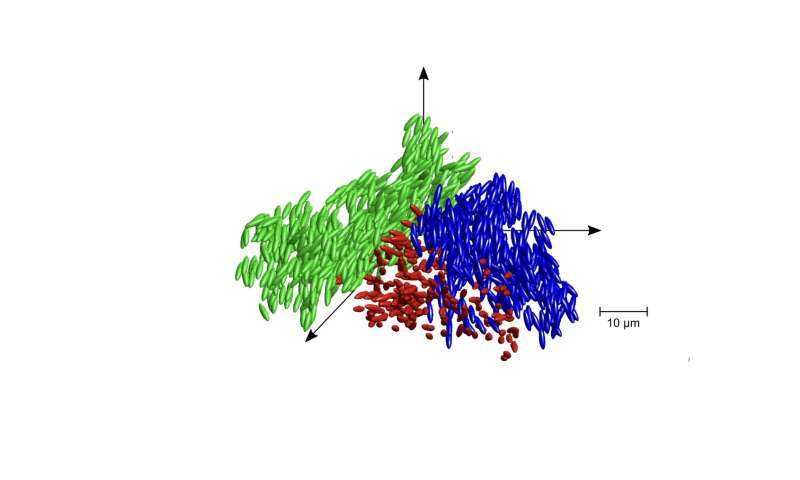
Research led by professors Andreas Zumbusch (Department of Chemistry) and Matthias Fuchs (Department of Physics), both based at the University of Konstanz, has just added another layer of complexity to the glass conundrum. Using a model system involving suspensions of tailor-made ellipsoidal colloids, the researchers uncovered a new state of matter, liquid glass, where individual particles are able to move yet unable to rotateโ€”complex behavior that has not previously been observed in bulk glasses. The results are published in the Proceedings of the National Academy of Sciences.

Colloidal suspensions are mixtures or fluids that contain solid particles which, at sizes of a micrometer (one millionth of a meter) or more, are bigger than atoms or molecules and therefore well-suited to investigation with optical microscopy. They are popular among scientists studying glass transitions because they feature many of the phenomena that also occur in other glass-forming materials.
 
3
•••
Researchers report new state of matter described as 'liquid glass'

Discovery of liquid glass sheds light on the old scientific problem of the glass transition: An interdisciplinary team of researchers from the University of Konstanz has uncovered a new state of matter, liquid glass, with previously unknown structural elementsโ€”new insights into the nature of glass and its transitions.

5ff463ff65bca.jpg


Research led by professors Andreas Zumbusch (Department of Chemistry) and Matthias Fuchs (Department of Physics), both based at the University of Konstanz, has just added another layer of complexity to the glass conundrum. Using a model system involving suspensions of tailor-made ellipsoidal colloids, the researchers uncovered a new state of matter, liquid glass, where individual particles are able to move yet unable to rotateโ€”complex behavior that has not previously been observed in bulk glasses. The results are published in the Proceedings of the National Academy of Sciences.

Colloidal suspensions are mixtures or fluids that contain solid particles which, at sizes of a micrometer (one millionth of a meter) or more, are bigger than atoms or molecules and therefore well-suited to investigation with optical microscopy. They are popular among scientists studying glass transitions because they feature many of the phenomena that also occur in other glass-forming materials.
It seems that Liquid Glass could be added to the four existing stats of matter. Liquid Crystal was named the fourth state of matter a few time ago.

"The well-known three states of matter are solid, liquid and gas. When cooled, gas condenses to form a liquid as you see in a warm room in winter where water vapor forms dew on glass windows cooled by the cold air outside."

"Liquid crystal is the fourth state of matter that occurs between solid and liquid. While studying the function of cholesterol in plants, Friedrich Reinitzer, an Austrian botanist, found an unusual melting that was always accompanied by the presence of cloudy liquid state before the clear liquid appears. This cloudy liquid is what is now known as "liquid crystal."
 
Last edited:
3
•••
Astronomers agree: Universe is nearly 14 billion years old

From an observatory high above Chileโ€™s Atacama Desert, astronomers have taken a new look at the oldest light in the universe.

Their observations, plus a bit of cosmic geometry, suggest that the universe is 13.77 billion years old โ€“ give or take 40 million years. A Cornell researcher co-authored one of two papers about the findings, which add a fresh twist to an ongoing debate in the astrophysics community.
 
4
•••
New Research Shows High Bodily Emissions During Workouts, Intensified by Chemical Reactions With Cleaners

One sweaty, huffing, exercising person emits as many chemicals from their body as up to five sedentary people, according to a new University of Colorado Boulder study. And notably, those human emissions, including Amino acids from sweat or acetone from breath, chemically combine with bleach cleaners to form new airborne chemicals with unknown impacts to indoor air quality.

https://scitechdaily.com/new-resear...ensified-by-chemical-reactions-with-cleaners/
 
2
•••
Researchers report new state of matter described as 'liquid glass'

Discovery of liquid glass sheds light on the old scientific problem of the glass transition: An interdisciplinary team of researchers from the University of Konstanz has uncovered a new state of matter, liquid glass, with previously unknown structural elementsโ€”new insights into the nature of glass and its transitions.

5ff463ff65bca.jpg


Research led by professors Andreas Zumbusch (Department of Chemistry) and Matthias Fuchs (Department of Physics), both based at the University of Konstanz, has just added another layer of complexity to the glass conundrum. Using a model system involving suspensions of tailor-made ellipsoidal colloids, the researchers uncovered a new state of matter, liquid glass, where individual particles are able to move yet unable to rotateโ€”complex behavior that has not previously been observed in bulk glasses. The results are published in the Proceedings of the National Academy of Sciences.

Colloidal suspensions are mixtures or fluids that contain solid particles which, at sizes of a micrometer (one millionth of a meter) or more, are bigger than atoms or molecules and therefore well-suited to investigation with optical microscopy. They are popular among scientists studying glass transitions because they feature many of the phenomena that also occur in other glass-forming materials.


It seems that Liquid Glass could be added to the four existing stats of matter. Liquid Crystal was named the fourth state of matter a few time ago.

"The well-known three states of matter are solid, liquid and gas. When cooled, gas condenses to form a liquid as you see in a warm room in winter where water vapor forms dew on glass windows cooled by the cold air outside."

"Liquid crystal is the fourth state of matter that occurs between solid and liquid. While studying the function of cholesterol in plants, Friedrich Reinitzer, an Austrian botanist, found an unusual melting that was always accompanied by the presence of cloudy liquid state before the clear liquid appears. This cloudy liquid is what is now known as "liquid crystal."

So whatever happened to plasma being the fourth state of matter?
 
Last edited:
3
•••
So whatever happened to plasma being the fourth state of matter?

That is what I thought too. May be a consensus among scientists is lacking.
 
2
•••
NASA Space Launch System Rocket Proceeding with Green Run Hot Fire

dsc_8766.jpg

A total of 114 tanker trucks delivered propellant to six propellant barges next to the B-2 Test Stand at NASAโ€™s Stennis Space Center near Bay St. Louis, Mississippi. The barges deliver more than 733,000 gallons of liquid hydrogen and liquid oxygen to the core stage for NASAโ€™s Space Launch System (SLS) rocket as part of the seventh test in the Green Run test series. Credits: NASA

NASA is targeting the final test in the Green Run series, the hot fire, for as early as Jan.17. The hot fire is the culmination of the Green Run test series, an eight-part test campaign that gradually brings the core stage of the Space Launch System (SLS) โ€” the deep space rocket that will power the agencyโ€™s next-generation human Moon missions โ€” to life for the first time.

https://www.nasa.gov/exploration/systems/sls/proceeding-with-green-run-hot-fire.html


Green Run test series

The test series culminates with this โ€œhot fireโ€ as all four RS-25 engines fire simultaneously.

During Green Run testing in the B-2 Test Stand, the RS-25 engine thrust peaks at 1.6 million pounds, which is the maximum thrust the engines produce at sea level on the launch pad, while maximum thrust is 2 million pounds at altitude.

It will be quite a show and I hope everything goes smoothly.
 
Last edited:

3
•••
Pluridisciplinary evidence for burial for the La Ferrassie 8 Neandertal child

The origin of funerary practices has important implications for the emergence of so-called modern cognitive capacities and behaviour.

...We provide new multidisciplinary information on the archaeological context of the La Ferrassie 8 Neandertal skeleton.

https://www.nature.com/articles/s41598-020-77611-z
 
Last edited:
3
•••
3
•••
Appraise.net
Spaceship
Domain Recover
DomainEasy โ€” Live Options
  • The sidebar remains visible by scrolling at a speed relative to the pageโ€™s height.
Back