NameSilo

discuss Science & Technology news & discussion

NamecheapNamecheap
Watch

CraigD

Top Member
Impact
11,745
Post and discuss interesting articles & videos about science and technology.

You don't need to be an expert - just interested in the wonders of modern science, technology, and the history of these fields.

Please keep it rational, and post articles from reputable sources.
Try not to editorialise headlines and keep the copy to just a paragraph with a link to the original source. When quoting excerpts from articles, I think the best method is to italicise the copy, and include a link to the source.

Have some fun with your comments and discussions... just keep the sources legitimate.

Other threads:
The Break Room has a number of other popular threads, so there is no need to post material here that is better suited to these other threads:

- Covid19-Coronavirus updates and news
- Conspiracy Thread Free For All
- The *religious* discussion thread


Please enjoy!
 
Last edited:
13
•••
The views expressed on this page by users and staff are their own, not those of NamePros.
AfternicAfternic
Building Earth's largest telescope on the far side of the moon

NASA engineers are studying the feasibility of building a massive, kilometre-wide radio telescope on the moon that would dwarf anything we could build on Earth.

The telescope, which would be constructed by robots, would take the form of a huge, wire-mesh antenna in a dish shape that would hang suspended in a three-kilometre-wide crater on the far side of the moon.


The Lunar Crater Radio Telescope would provide a unique perspective on the early universe, though it likely won't be built for decades, according to NASA robotics engineer Saptarshi Bandyopadhyay, who is leading the project.

lunar-crater-telescope-deployment.jpg


For now, this is an early stage engineering feasibility study, rather than a fully developed mission proposal, but Bandyopadhyay suggests it would certainly be expensive and would be a very high-profile endeavour for NASA

https://www.nasa.gov/directorates/spacetech/niac/2020_Phase_I_Phase_II/lunar_crater_radio_telescope/
 
Last edited:
1
•••
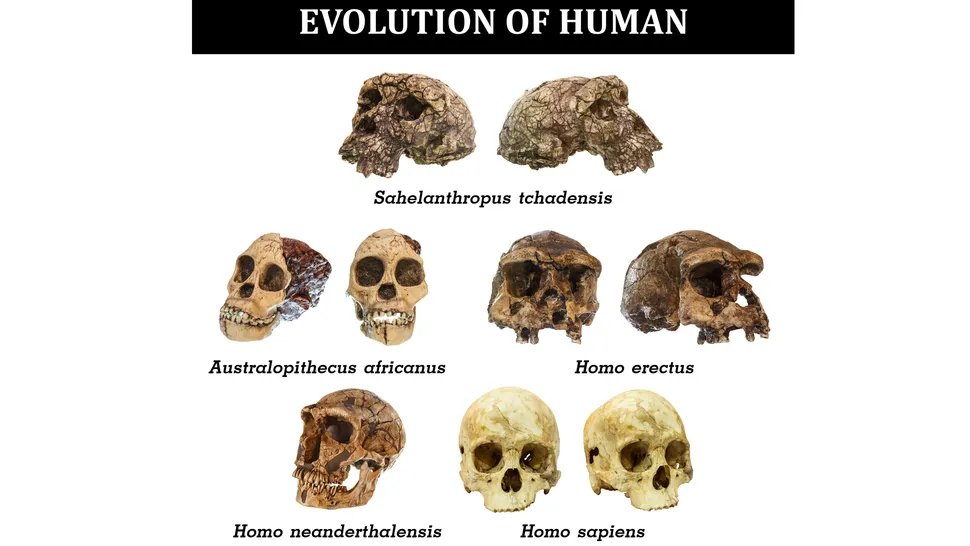
How many early human species existed on Earth?

The chimpanzee and us have evolved from a common ancestor," Stewart said. If we decide that humans are everything that arrived after our split from ancient chimpanzees about 6 million to 7 million years ago, then it's likely to be a diverse group. The Smithsonian National Museum of Natural History has listed at least 21 human species that are recognized by most scientists. Granted, it's not a totally complete list; the Denisovans, for instance, are missing.

TXRzb4EjJMshkYMHX8Hjin-970-80.jpg.webp


Those on the list include Homo sapiens, Neanderthals, the Indonesian hobbit-size people, Homo erectus and Homo naledi. The list also includes other species that existed closer in time to the common ancestor of humans and chimps, and so look more like chimpanzees than modern-day humans. Despite their looks, these species are still known as early humans. "You can't go back 5 million years and expect them to look like us," Stewart said.

If the Smithsonian says there are 21, then you can be sure the diversity is much greater, Stewart said. That’s because the list errs on the side of caution, picking the species that are close to universally recognized. For instance, the recently discovered dwarf human species Homo luzonensis, who is known from just a few bones unearthed in an Indonesian cave, is not included on the Smithsonian's list.

Researchers also suspect there are many other fossilized species yet to be excavated. "The list has only ever grown and I don’t see why that will change," Stewart said.
 
2
•••
Last edited:

3
•••
1
•••
Need a lift? SpaceX launches record spacecraft in cosmic rideshare program

A veteran rocket from billionaire entrepreneur Elon Musk’s SpaceX aerospace company launched 143 spacecraft into space on Sunday, a new record for the most spaceships deployed on a single mission, according to the company.

The Falcon 9 rocket lifted off at 10 a.m. EST from the Space Launch Complex 40 at Cape Canaveral Space Force Station in Florida. It flew south along the eastern coast of Florida on its way to space, the company said.

The reusable rocket ferried 133 commercial and government spacecraft and 10 Starlink satellites to space - part of the company’s SmallSat Rideshare Program, which provides access to space for small satellite operators seeking a reliable, affordable ride to orbit, according to the company.

https://www.reuters.com/article/us-...aft-in-cosmic-rideshare-program-idUSKBN29T0OI
 
Last edited:
1
•••
Climate change will cause a shift in Earth's tropical rain belt — threatening water and food supply for billions, study says

By 2100, billions of people are at risk of facing more flooding, higher temperatures and less food and water. A new study published in "Nature Climate Change" found that the climate change will cause the Earth's tropical rain belt to unevenly shift in areas that cover almost two-thirds of the world, potentially threatening environmental safety and food security for billions of people.

The tropical rain belt, otherwise known as the Intertropical Convergence Zone, or ITCZ, is a narrow area that circles the Earth near the equator where trade winds from the Northern and Southern hemispheres meet. Areas along the equator are among the warmest on Earth, and this, paired with the winds, creates significant humidity and precipitation.

"Our work shows that climate change will cause the position of Earth's tropical rain belt to move in opposite directions in two longitudinal sectors that cover almost two thirds of the globe," lead author Antonios Mamalakis said in a statement, "a process that will have cascading effects on water availability and food production around the world."

https://www.cbsnews.com/news/climate-change-tropical-rain-belt-water-food-supply/
 
2
•••
A curious observer’s guide to quantum mechanics, pt. 3: Rose colored glasses

“How big is a particle?” Well, that's a subtle (and, unsurprisingly, complex) question.

So far, we’ve seen particles move as waves and learned that a single particle can take multiple, widely separated paths. There are a number of questions that naturally arises from this behavior—one of them being, “How big is a particle?” The answer is remarkably subtle, and over the next two weeks (and articles) we'll explore different aspects of this question.

Today, we’ll start with a seemingly simple question: “How long is a particle?”

https://arstechnica.com/science/202...-quantum-mechanics-pt-3-rose-colored-glasses/
 
2
•••
"Against All Odds" - NASA's Planet-Hunting Tess Discovers a Unique Star System with Six 'Suns'

23TB-SEXTUPLETS3-jumbo-e1611419141623.jpg


“The system exists against the odds,” said Brian Powell, a data scientist at NASA’s High Energy Astrophysics Science Archive Research Center about the source of starlight that was mysteriously brightening and dimming some 1,900 light-years away. The source, named TIC 168789840, is a system of three pairs of binary stars: three different stellar couplets revolving around three different centers of mass, but with the trio remaining gravitationally bound to one another and circling the galactic center as a single star system.

https://dailygalaxy.com/2021/01/aga...ue-star-system-with-six-suns-weekend-feature/
 
2
•••
"Against All Odds" - NASA's Planet-Hunting Tess Discovers a Unique Star System with Six 'Suns'

23TB-SEXTUPLETS3-jumbo-e1611419141623.jpg


“The system exists against the odds,” said Brian Powell, a data scientist at NASA’s High Energy Astrophysics Science Archive Research Center about the source of starlight that was mysteriously brightening and dimming some 1,900 light-years away. The source, named TIC 168789840, is a system of three pairs of binary stars: three different stellar couplets revolving around three different centers of mass, but with the trio remaining gravitationally bound to one another and circling the galactic center as a single star system.

https://dailygalaxy.com/2021/01/aga...ue-star-system-with-six-suns-weekend-feature/
Three suns were already a lot, but six clearly break the record :xf.smile:
 
Last edited:
1
•••
Six Stars, Six Eclipses: ‘The Fact That It Exists Blows My Mind’

https://www.nytimes.com/2021/01/23/science/six-stars-eclipses.html

"The source, named TIC 168789840, is a system of six stars. That alone makes it a rarity, but what makes this sextuplet even more remarkable is that they consist of three pairs of binary stars: three different stellar couplets revolving around three different centers of mass, but with the trio remaining gravitationally bound to one another and circling the galactic center as a single star system.

In other words, scientists have found a sextuply eclipsing sextuple star system. The discovery, posted online this month, has been accepted for publication in The Astronomical Journal."
 
1
•••
Australian lungfish has largest genome of any animal sequenced so far

The Australian lungfish has the largest genome of any animal so far sequenced.

Siegfried Schloissnig at the Research Institute of Molecular Pathology in Austria and his colleagues have found that the lungfish’s genome is 43 billion base pairs long, which is around 14 times larger than the human genome.

Its genome is 30 per cent larger than that of the previous record holder: the axolotl, a Mexican amphibian that the team sequenced in 2018.


lungfishgenome_web.jpg


The new genomic analysis shows unequivocally that lungfish are more closely linked to the evolutionary line that gave rise to four-legged animals. Coelacanths diverged earlier, while lungfish branched off 420 million years ago.

“In order to get out of the water, you need to adapt towards a terrestrial lifestyle,” says Schloissnig. “You have to be able to breathe air, you have to be able to smell.”


The Australian lungfish is similar to amphibians when it comes to the raw number of genes associated with the development of lungs and articulated limbs, as well as the detection of air-borne smells.

“When you look at it from a genomic perspective, it is genomically halfway between a fish and a land-based vertebrate,
” says Schloissnig.
 
Last edited:
3
•••
Wet and wild: There's lots of water in the world's most explosive volcano

https://phys.org/news/2021-01-wild-lots-world-explosive-volcano.html

"There isn't much in Kamchatka, a remote peninsula in northeastern Russia just across the Bering Sea from Alaska, besides an impressive population of brown bears and the most explosive volcano in the world.

Kamchatka's Shiveluch volcano has had more than 40 violent eruptions over the last 10,000 years. The last gigantic blast occurred in 1964, creating a new crater and covering an area of nearly 100 square kilometers with pyroclastic flows."
 
3
•••
Elon Musk to offer $100 million prize for 'best' carbon capture tech

https://www.nbcnews.com/science/env...illion-prize-best-carbon-capture-tech-rcna234


"Tesla chief and billionaire entrepreneur Elon Musk on Thursday took to Twitter to promise a $100 million prize for development of the “best” technology to capture carbon dioxide emissions."

--------------------

I want my prize:


Tree planting 'has mind-blowing potential' to tackle climate crisis

https://www.theguardian.com/environ...le-climate-crisis-scientists-canopy-emissions

"Planting billions of trees across the world is one of the biggest and cheapest ways of taking CO2 out of the atmosphere to tackle the climate crisis, according to scientists, who have made the first calculation of how many more trees could be planted without encroaching on crop land or urban areas."

"As trees grow, they absorb and store the carbon dioxide emissions that are driving global heating. New research estimates that a worldwide planting programme could remove two-thirds of all the emissions from human activities that remain in the atmosphere today, a figure the scientists describe as “mind-blowing”.
 
Last edited:
3
•••
Six Stars, Six Eclipses: ‘The Fact That It Exists Blows My Mind’

https://www.nytimes.com/2021/01/23/science/six-stars-eclipses.html

"The source, named TIC 168789840, is a system of six stars. That alone makes it a rarity, but what makes this sextuplet even more remarkable is that they consist of three pairs of binary stars: three different stellar couplets revolving around three different centers of mass, but with the trio remaining gravitationally bound to one another and circling the galactic center as a single star system.

In other words, scientists have found a sextuply eclipsing sextuple star system. The discovery, posted online this month, has been accepted for publication in The Astronomical Journal."

It sounds amazing - and from reading the articles I still cannot figure out exactly how the system works.

Physicists and mathematicians will no doubt be scratching their heads over the equations for years to come.
 
2
•••
The Phantom Biosphere — “An Alien Life-Form May Exist Hidden in Earth’s Microbial World”

A Hidden 1st, 2nd, 3rd Genesis?

Just a Single Microbe of Life as We Don’t Know It

All it would take to settle the “question are we alone” Davies concludes, “is the discovery of a single microbe – just one – which represents life, but not as we know it. If we had in our hands (or rather under our microscopes) an organism whose biochemistry was sufficiently unlike our own that an independent genesis was unavoidable, the case for a fecund universe would be made.”

If life can happen twice, Davies suggests, it can happen a zillion times. “And that single alien microbe doesn’t have to be on some far-flung planet; it could be here on Earth. It could be discovered tomorrow, upending our vision of the cosmos and mankind’s place within it and greatly boosting the prospect that intelligent life may be out there somewhere.”


https://dailygalaxy.com/2021/01/the...might-exist-hidden-in-earths-microbial-world/


We've yet to find any evidence of a 'second genesis' which is why I am sceptical that life exists outside our solar system, but this is a very interesting article worth a read...
 
Last edited:
3
•••
Elon Musk to offer $100 million prize for 'best' carbon capture tech

I want my prize:

Tree planting 'has mind-blowing potential' to tackle climate crisis

Nice try, but when the tree dies or wood burns, the carbon is released back into the atmosphere.

Next entry?
 
Last edited:
2
•••
A quarter of all known bee species haven't been seen since the 1990s

22-jan_lost-bees.jpg


The number of bee species recorded worldwide has been sharply decreasing since the 1990s.

Eduardo Zattara and Marcelo Aizen at the National University of Comahue in Argentina analysed how many wild bee species are observed each year as recorded in the Global Biodiversity Information Facility – a publicly available platform where researchers and citizens can record sightings of bee species.

They found that there were a quarter fewer species reported between 2006 and 2015, as compared with the records we have from before 1990.

The decline is especially alarming considering the number of bee records in this database has increased by around 55 per cent since 2000, so it isn’t down to a lack of observations.

https://www.newscientist.com/article/2265680-a-quarter-of-all-known-bee-species-havent-been-seen-since-the-1990s/
 
Last edited:
1
•••
Nice try, but when the tree dies or wood burns, the carbon is released back into the atmosphere.

Next entry?
Yes, but they won't burn in the same amount and at the same time. In fact, with only the trees that have been cut down and without deforestation that have been made till today, the amount of CO2 in the air would be way lower.
Trees are the natural way to absorb CO2, and yearly deforestation will be definitely one of the causes for the next climate catastrophe. Not only they absorb CO2 but they produce oxygen, and we are destroying Earth's lungs.
 
3
•••
Yes, but they won't burn in the same amount and at the same time. In fact, with only the trees that have been cut down and without deforestation that have been made till today, the amount of CO2 in the air would be way lower.
Trees are the natural way to absorb CO2, and yearly deforestation will be definitely one of the causes for the next climate catastrophe. Not only they absorb CO2 but they produce oxygen, and we are destroying Earth's lungs.

Here's a question you might be able to answer:

Given that most plants uptake CO² and release oxygen during the day via photosynthesis and uptake oxygen and release CO² during the night via respiration, how much does this balance out?
 
2
•••
Given that most plants uptake CO² and release oxygen during the day via photosynthesis and uptake oxygen and release CO² during the night via respiration, how much does this balance out?
The result is clearly more Oxygen and less CO2:

The Power of One Tree - The Very Air We Breathe

https://www.usda.gov/media/blog/2015/03/17/power-one-tree-very-air-we-breathe

"A tree has the ability to provide an essential of life for all living things on our planetoxygen, and the power to remove harmful gases like carbon dioxide making the air we breathe healthier.

It is proposed that one large tree can provide a day’s supply of oxygen for up to four people.

Trees also store carbon dioxide in their fibers helping to clean the air and reduce the negative effects that this CO2 could have had on our environment. According to the Arbor Day Foundation, in one year a mature tree will absorb more than 48 pounds of carbon dioxide from the atmosphere and release oxygen in exchange."
 
Last edited:

3
•••
Appraise.net

We're social

Spaceship
Domain Recover
NameMaxi - Your Domain Has Buyers
  • The sidebar remains visible by scrolling at a speed relative to the page’s height.
Back