Dynadot โ€” .com Transfer

discuss Science & Technology news & discussion

SpaceshipSpaceship
Watch

CraigD

Top Member
Impact
11,745
Post and discuss interesting articles & videos about science and technology.

You don't need to be an expert - just interested in the wonders of modern science, technology, and the history of these fields.

Please keep it rational, and post articles from reputable sources.
Try not to editorialise headlines and keep the copy to just a paragraph with a link to the original source. When quoting excerpts from articles, I think the best method is to italicise the copy, and include a link to the source.

Have some fun with your comments and discussions... just keep the sources legitimate.

Other threads:
The Break Room has a number of other popular threads, so there is no need to post material here that is better suited to these other threads:

- Covid19-Coronavirus updates and news
- Conspiracy Thread Free For All
- The *religious* discussion thread


Please enjoy!
 
Last edited:
13
•••
The views expressed on this page by users and staff are their own, not those of NamePros.
AfternicAfternic
Small, quiet crickets turn leaves into megaphones to blare their mating call

Some male crickets make their own megaphones by cutting wing-sized holes into the center of leaves. With their bodies stuck halfway through this vegetative speaker, male Oecanthus henryi crickets can more than double the volume of their calls, allowing naturally quiet males to attract as many females as loud males, researchers report December 16 in Proceedings of the Royal Society B.

Itโ€™s a rare example of insect tool use that โ€œreally challenges you to think about what it takes to produce complex behavior,โ€ says Marlene Zuk, an evolutionary biologist at the University of Minnesota in St. Paul who wasnโ€™t involved in the study.


121520_jl_crickets_feat-1030x580.jpg


I conclude that gender ratio of cricket population was highly skewed in favor of males, where I spent my childhood. :xf.grin:
 
Last edited:
1
•••
Moon Influences Arctic Ocean Methane Releases, Study Finds

img.jpg


The moon helps to control the release of methane from the Arctic Ocean.

That's the takeaway from a study published in Nature Communications in October, which found that the tidal rhythms played a role in the intensity and frequency of methane releases from sediments in the Arctic Ocean. Lower tides meant more intense releases, while higher tides reduced the height and volume of gas releases.

To achieve their results, the researchers put a device called a piezometer in Arctic Ocean sediment about a meter (approximately 3.28 feet) from the seafloor and left it there for four days. The piezometer measured the pressure and temperature of sediment pours every hour and revealed that the upward and downward movement of gas is linked to pressure, which is in turn determined by the tides.

"Low tide means less of such hydrostatic pressure and higher intensity of methane release. High tide equals high pressure and lower intensity of the release," study coauthor Andreia Plaza Faverola, also of CAGE, said in the press release.
 
Last edited:
2
•••
To the brain, reading computer code is not the same as reading language

In some ways, learning to program a computer is similar to learning a new language. It requires learning new symbols and terms, which must be organized correctly to instruct the computer what to do. The computer code must also be clear enough that other programmers can read and understand it.


In spite of those similarities, MIT neuroscientists have found that reading computer code does not activate the regions of the brain that are involved in language processing. Instead, it activates a distributed network called the multiple demand network, which is also recruited for complex cognitive tasks such as solving math problems or crossword puzzles.


However, although reading computer code activates the multiple demand network, it appears to rely more on different parts of the network than math or logic problems do, suggesting that coding does not precisely replicate the cognitive demands of mathematics either.
 
Last edited:
4
•••
1
•••
Last edited:

3
•••
Oceanographers have an explanation for the Arctic's puzzling ocean turbulence

Eddies are often seen as the weather of the ocean. Like large-scale circulations in the atmosphere, eddies swirl through the ocean as slow-moving sea cyclones, sweeping up nutrients and heat, and transporting them around the world.

In most oceans, eddies are observed at every depth and are stronger at the surface. But since the 1970s, researchers have observed a peculiar pattern in the Arctic...

https://phys.org/news/2020-12-oceanographers-explanation-arctic-puzzling-ocean.html
 
3
•••
The farthest galaxy in the universe

A team of astronomers used the Keck I telescope to measure the distance to an ancient galaxy. They deduced the target galaxy GN-z11 is not only the oldest galaxy but also the most distant. It's so distant it defines the very boundary of the observable universe itself. The team hopes this study can shed light on a period of cosmological history when the universe was only a few hundred million years old.

https://phys.org/news/2020-12-farthest-galaxy-universe.html
 
4
•••
The farthest galaxy in the universe

A team of astronomers used the Keck I telescope to measure the distance to an ancient galaxy. They deduced the target galaxy GN-z11 is not only the oldest galaxy but also the most distant. It's so distant it defines the very boundary of the observable universe itself. The team hopes this study can shed light on a period of cosmological history when the universe was only a few hundred million years old.

https://phys.org/news/2020-12-farthest-galaxy-universe.html
Very interesting. Just think that the image of that galaxy is "13.4 billion light years" old. By now, that Galaxy just may have changed or evolved a lot.
 
2
•••
Hubblecast 133: Spectroscopy with Hubble


This Hubblecast explores how the NASA/ESA Hubble Space Telescopeโ€™s observations differ across different wavelengths of the electromagnetic spectrum, and how these observations will be complemented by those of the upcoming NASA/ESA/CSA James Webb Space Telescope.

 
1
•••
0
•••
1
•••
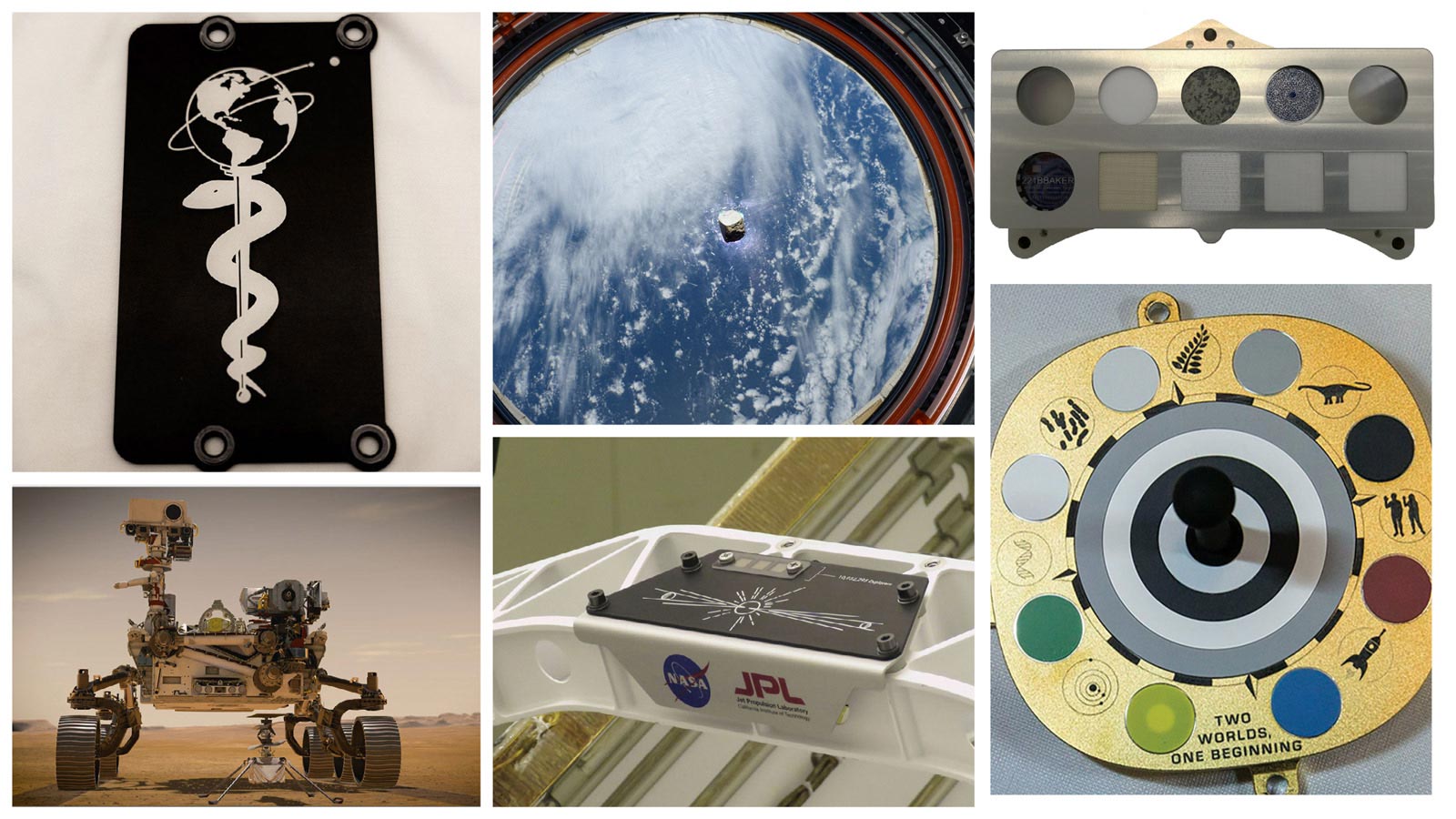
NASAโ€™s Perseverance Rover Has 5 Hidden Gems Riding Aboard to Mars

More than halfway to the Red Planet, NASAโ€™s Perseverance Mars rover isnโ€™t just shuttling sophisticated science instruments and tubes to be filled with Earth-bound rock samples. Itโ€™s carrying symbols, mottos, and objects that range from practical to playful โ€” everything from meteorite fragments to chips carrying the names of 10.9 million people.

https://scitechdaily.com/nasas-perseverance-rover-has-5-hidden-gems-riding-aboard-to-mars/


NASA-Perseverance-Mars-Rover-Festooned.jpg
 
1
•••
Universality of Human Emotional Expression: The 16 Facial Expressions Most Common Worldwide

First, researchers used Cowenโ€™s machine-learning algorithm to log facial expressions shown in 6 million video clips of events and interactions worldwide, such as watching fireworks, dancing joyously, or consoling a sobbing child.

They used the algorithm to track instances of 16 facial expressions one tends to associate with amusement, anger, awe, concentration, confusion, contempt, contentment, desire, disappointment, doubt, elation, interest, pain, sadness, surprise, and triumph.

Next, they correlated the facial expressions with the contexts and scenarios in which they were made across different world regions and discovered remarkable similarities in how people across geographic and cultural boundaries use facial expressions in different social contexts.


16-Universal-Facial-Expressions.jpg
 
1
•••
Experimental "Faraday fabric" blocks almost all electromagnetic waves

Researchers at Drexel University have created โ€œFaraday fabricsโ€ that can block almost all electromagnetic waves. The key ingredient is a 2D material called MXene, and the development could help protect wearables from interference and people from potentially dangerous radiation.

https://newatlas.com/materials/faraday-fabric-mxene-blocks-electromagnetic-waves/

I used to sell emf maternity aprons before they became a thing...even before cell phones became popular (damn, seems I'm always a couple decades ahead of my time, lol)

Arctic sea ice's dramatic transformation revealed through 42 years of satellite data

The vanishing Arctic: Since the mid-80s the Arctic has been warming twice as fast as the entire world โ€” a phenomenon the vast majority of scientists agree is the direct result of human-induced climate change.

https://www.abc.net.au/news/2020-12...transformation-as-seen-by-satellites/12961584

I've been studying Arctic geography since the early 80's, and predicted (through geomancy and Indigenous wisdom) this would be the result. Few people listened to me then, and still today there is resistance to change. Now 40 years later, we are seeing the result. I suspect it will get worse before it gets better. I also predicted Global cooling from nuclear winter that will bring on another Ice Age once particulate laden clouds fill the sky blocking out sunlight. (btw nuclear winter doesn't necessarily mean as a result of nuclear bombs), but from clouds formed through evaporation and particulate released from power plant emmissions - as additional cooling is required due to Global warming ie. AC.

Oceanographers have an explanation for the Arctic's puzzling ocean turbulence

Eddies are often seen as the weather of the ocean. Like large-scale circulations in the atmosphere, eddies swirl through the ocean as slow-moving sea cyclones, sweeping up nutrients and heat, and transporting them around the world.

In most oceans, eddies are observed at every depth and are stronger at the surface. But since the 1970s, researchers have observed a peculiar pattern in the Arctic...

https://phys.org/news/2020-12-oceanographers-explanation-arctic-puzzling-ocean.html

That's most likely due to the mixing of fresh water (melting ice) with salt water in the Arctic Ocean. It also affects the global conveyor belt, a huge solar energy sink that disperses and moderates heat around the planet. These currents are also extremely important in driving the base of the food chain, as they stir up and mix nutrients - photoplankton and zooplankton. Without this mechanism, oceans would die.
 
Last edited:
4
•••
As well as pollution from factories and power plants, dust particles from dry land due to drought and desertification will end up in the atmosphere. It's happening in China and the same thing led to collapse of the Mayan Empire.

https://www.worldbank.org/en/news/f...sertification-and-boosting-incomes-in-ningxia

https://www.inverse.com/article/47758-maya-empire-collapse-drought-theory

Not only will dust add to nuclear winter, but "silica, which makes up ~60% of windblown dust from desert regions, is known to cause chronic lung inflammation and fibrosis, lung cancer, and systemic autoimmune diseases." This will become particularly prevalent across the US south-west.

https://iopscience.iop.org/article/10.1088/1748-9326/aabf20/meta
 
3
•••
3
•••
Meet Au-Spot, the AI robot dog that's training to explore caves on Mars

MB5nnnMraQPTs9HqgDowZR-320-80.jpg


Scientists are equipping four-legged, animal-mimicking robots with artificial intelligence (AI) and an array of sensing equipment to help the bots autonomously navigate treacherous terrain and subsurface caves on the Red Planet.

In a presentation on Dec. 14 at the annual meeting of the American Geophysical Union (AGU), held online this year, researchers with NASA/JPL-Caltech introduced their "Mars Dogs," which can maneuver in ways the iconic wheeled rovers such as Spirit, Opportunity, Curiosity and the recently launched Perseverance never could. The new robots' agility and resilience are coupled with sensors that allow them to avoid obstacles, choose between multiple paths and build virtual maps of buried tunnels and caverns for operators at home base, scientists said at AGU.

 
2
•••
US cybersecurity agency warns of 'grave threat' after 'critical infrastructure' hacked

Nukes safe but personal info may have been exposed.

US authorities have expressed increased alarm about a long-undetected intrusion into computer systems around the world that officials suspect was carried out by Russian hackers. The nation's cybersecurity agency has warned of a "grave" risk to government and private networks, after federal agencies and "critical infrastructure" were hacked in a sophisticated attack.

https://www.abc.net.au/news/2020-12-18/hack-against-us-is-grave-threat-cybersecurity-agency-solar-wind/12997062

Seriously concerning that this has only just now been discovered and disclosed.
 
Last edited:
2
•••
"From previous studies, the galaxy GN-z11 seems to be the farthest detectable galaxy from us, at 13.4 billion light years, or 134 nonillion kilometers (that's 134 followed by 30 zeros),"

Nonillion, that's the biggest number I've ever seen!! (or heard of) :jawdrop:

First time I have ever encountered it also.

Googol derivatives have bigger numbers though it's all academic when we cannot appreciate the sizes.

A Googol is a 1 followed by 100 zeroes.
A Googolplex is a 1 followed by Googol zeroes.

Graham's number is on another level altogether, and hurts my brain.
The observable universe is far too small to contain an ordinary digital representation of Graham's number, assuming that each digit occupies one Planck volume, possibly the smallest measurable space
 
Last edited:
4
•••
Fermilab and Partners Achieve Sustained, High-Fidelity Quantum Teleportation

A viable quantum internet โ€” a network in which information stored in qubits is shared over long distances through entanglement โ€” would transform the fields of data storage, precision sensing and computing, ushering in a new era of communication.

This month, scientists at Fermilab, a U.S. Department of Energy Office of Science national laboratory, and their partners took a significant step in the direction of realizing a quantum internet.

In a paper published in PRX Quantum, the team presents for the first time a demonstration of a sustained, long-distance (44 kilometers of fiber) teleportation of qubits of photons (quanta of light) with fidelity greater than 90%. The qubits were teleported over a fiber-optic network using state-of-the-art single-photon detectors and off-the-shelf equipment.
 
3
•••
Dynadot โ€” .com TransferDynadot โ€” .com Transfer
Appraise.net
Spaceship
Domain Recover
CatchDoms
DomainEasy โ€” Payment Flexibility
  • The sidebar remains visible by scrolling at a speed relative to the pageโ€™s height.
Back