- Impact
- 470
Hi all,
I've been sitting on a paid-for sponsored post for 6 months. Today seemed like a good day to use it.
Why today? Two reasons:
On the one hand, I'm saddened by the departure of AFD. We've spent the last 9 years working within this ad channel and in that time it paid a lot of employee's bills and provided for a lot of families.
But, more importantly, I'm excited for the future of RSOC monetized domain traffic, so I won’t dwell in the Wayback Machine over AFD... let's dig in:
What is RSOC?
RSOC (Related Search on Content) is an ad unit in the Adsense for Search (AFS) ecosystem. It contains related search terms (RS's) similar to the first page of an AFD lander, but, unlike AFD, it lives within a page of content and derives its RS's from that content. When someone clicks an RS, they're brought to a search results page which lists sponsored results relevant to the clicked RS, as well as organic results. Publishers get paid when the visitor clicks a sponsored result.
Why the change? AFD was working great!
It was working great for publishers! Clearly it wasn't working so great for advertisers, who complained long enough and loudly enough that the AdWords team had to forcibly opt them all out of it.
The hope with RSOC is that by providing more contextual information to the visitors and embedding the unit within high-quality content, their ad clicks will be more productive for the advertisers. And the success of the advertisers should be important to all of us publishers as well; it's their money that powers our industry.
How is RSOC being implemented in Giant Panda? Will you put RSOC units on my domain?
No. RSOC ad units can only be invoked on fully-developed, pre-approved websites. The approval process can take weeks, and building a quality website for millions of domains (let alone shepherding them through a manual approval process) is just not viable.
Instead, we've built a network of content sites and populated them with high quality articles relevant to the many, many different types of visitor intent we've seen over our years optimizing organic domain traffic. And we have many, many, MANY more articles to write because, well, that's the nature of organic domain traffic.
In Phase 1 of the GP content network (happening now!) we are manually generating high-quality content, adding them to our network of pillar sites (a legal journal for law-related intent, a health and fitness magazine for health and fitness intent, a sports blog for sports-related intent, etc) and redirecting your domains' visitors to the relevant article that best meets their specific intent.
In Phase 2, we'll be repurposing Bamboo (our in-house AI platform) to generate content and match up visitor intent with that new content.
<sidenote> I never had a chance to explain Bamboo publicly, but we spent the better part of 2025 training it on a dataset of millions of traffic domains, teaching it how to accurately source the reason for a domain's traffic, define the intent of that traffic, and then create keywords (RS's) to best monetize the visitors' intent. Of course, the keyword creation is useless now!
But Bamboo's ability to source and define a domain visitor's intent is eerily good; instead of source traffic -> define intent -> generate keywords, it'll source -> define -> generate a full article. I'm excited to see how it performs generating content once we've worked it all out ourselves manually.</sidenote>
Once Phase 2 is complete, I expect we'll be able to monetize any and all high-quality organic traffic domains via RSOC and our content network.
How do I put a For Sale banner on my domain if it's being forwarded to a content site?
You don't. At least not at the moment.
In what I am now haphazardly calling Phase 1.5, we are building our own landing pages (with an option to add For Sale banners) for clients who want to continue listing their domains for sale while monetizing them. The landing pages will contain keywords that lead to a relevant content page and/or generic offers. Yes, the extra click will negatively impact revenue, but for many domainers the opportunity is worth the cost.
When do I make money?
Short answer: when a visitor clicks an ad... just like AFD.
Long answer: AFS/RSOC is not currently designed to accommodate millions of traffic inputs the way AFD is/was. Most of our (brilliant!) development team's time over the past months has been dedicated to ensuring our ability to correctly attribute revenue to a referring domain. When your domain sends a visitor to one of our content sites, you will be paid for the revenue that visitor generates.
Ok... and HOW MUCH MONEY AM I GOING TO MAKE?
So here's the answer to the literal "million dollar question" which I'm assuming some percentage of you skipped to:
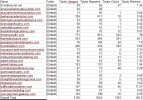
We have been testing RSOC-monetized content on our own portfolio for the past 6 weeks. Some cohorts of domains generate RPMs equivalent-to or greater-than AFD prior to January's 2nd page design change. Some cohorts generate RPMs more in line with what they were making earlier this year. In nearly every cohort, it outperforms RTB networks and the current dead-man-walking AFD.
The funnel click-through rates are lower, but the value of those clicks are much higher; not only because AFS has access to a wider variety of advertisers than AFD, but also because, I believe, the combination of laser-targeted intent and meaningful content allows the visitors to make more informed decisions. They aren't just clicking due to inertia, confusion, and dark pattern design the way they did on AFD.
And since I know some goofball is gonna challenge me, here's a screenshot (domains redacted):

Bottom line: RSOC is not only a viable path for domain traffic monetization: it's a productive path.
But it's not the only path!
Without the constraints of AFD, we're free to send domain traffic to wherever it can be most profitably monetized. Over the past few months we've set up 100's of affiliate/CPA offers, deepened our integrations with RTB networks, and are actively developing targeted monetization solutions to serve very specific cohorts of domains.
The future of natural domain traffic monetization ("parking" doesn't feel like the right word anymore) will be a combination
of RSOC-enabled content, affiliate/CPA offers, RTB for high-volume/low-value traffic, and any creative monetization ideas we conceive along the way to wring the most value from your (and our!) domains' visitors.
Domain monetization isn't dead; it's evolving. But there's light on the horizon, and I hope many of you will join us to help bring our little cottage industry into it.
If you already have a Giant Panda account, shoot me an email ([email protected]) and I'll see about prioritizing your domains for RSOC monetization.
If you don't have a Giant Panda account and you have natural domain traffic (no arb!) start an application here:
https://account.giantpanda.com/accounts/create/
I've been sitting on a paid-for sponsored post for 6 months. Today seemed like a good day to use it.
Why today? Two reasons:
- Because I just received official word that AFD, the foundation of domain monetization for the past decade, is ending effective February 10, 2026.
- Because as of today, we have officially begun monetizing GiantPanda client names at our RSOC-monetized content network.
On the one hand, I'm saddened by the departure of AFD. We've spent the last 9 years working within this ad channel and in that time it paid a lot of employee's bills and provided for a lot of families.
But, more importantly, I'm excited for the future of RSOC monetized domain traffic, so I won’t dwell in the Wayback Machine over AFD... let's dig in:
What is RSOC?
RSOC (Related Search on Content) is an ad unit in the Adsense for Search (AFS) ecosystem. It contains related search terms (RS's) similar to the first page of an AFD lander, but, unlike AFD, it lives within a page of content and derives its RS's from that content. When someone clicks an RS, they're brought to a search results page which lists sponsored results relevant to the clicked RS, as well as organic results. Publishers get paid when the visitor clicks a sponsored result.
Why the change? AFD was working great!
It was working great for publishers! Clearly it wasn't working so great for advertisers, who complained long enough and loudly enough that the AdWords team had to forcibly opt them all out of it.
The hope with RSOC is that by providing more contextual information to the visitors and embedding the unit within high-quality content, their ad clicks will be more productive for the advertisers. And the success of the advertisers should be important to all of us publishers as well; it's their money that powers our industry.
How is RSOC being implemented in Giant Panda? Will you put RSOC units on my domain?
No. RSOC ad units can only be invoked on fully-developed, pre-approved websites. The approval process can take weeks, and building a quality website for millions of domains (let alone shepherding them through a manual approval process) is just not viable.
Instead, we've built a network of content sites and populated them with high quality articles relevant to the many, many different types of visitor intent we've seen over our years optimizing organic domain traffic. And we have many, many, MANY more articles to write because, well, that's the nature of organic domain traffic.
In Phase 1 of the GP content network (happening now!) we are manually generating high-quality content, adding them to our network of pillar sites (a legal journal for law-related intent, a health and fitness magazine for health and fitness intent, a sports blog for sports-related intent, etc) and redirecting your domains' visitors to the relevant article that best meets their specific intent.
In Phase 2, we'll be repurposing Bamboo (our in-house AI platform) to generate content and match up visitor intent with that new content.
<sidenote> I never had a chance to explain Bamboo publicly, but we spent the better part of 2025 training it on a dataset of millions of traffic domains, teaching it how to accurately source the reason for a domain's traffic, define the intent of that traffic, and then create keywords (RS's) to best monetize the visitors' intent. Of course, the keyword creation is useless now!
But Bamboo's ability to source and define a domain visitor's intent is eerily good; instead of source traffic -> define intent -> generate keywords, it'll source -> define -> generate a full article. I'm excited to see how it performs generating content once we've worked it all out ourselves manually.</sidenote>
Once Phase 2 is complete, I expect we'll be able to monetize any and all high-quality organic traffic domains via RSOC and our content network.
How do I put a For Sale banner on my domain if it's being forwarded to a content site?
You don't. At least not at the moment.
In what I am now haphazardly calling Phase 1.5, we are building our own landing pages (with an option to add For Sale banners) for clients who want to continue listing their domains for sale while monetizing them. The landing pages will contain keywords that lead to a relevant content page and/or generic offers. Yes, the extra click will negatively impact revenue, but for many domainers the opportunity is worth the cost.
When do I make money?
Short answer: when a visitor clicks an ad... just like AFD.
Long answer: AFS/RSOC is not currently designed to accommodate millions of traffic inputs the way AFD is/was. Most of our (brilliant!) development team's time over the past months has been dedicated to ensuring our ability to correctly attribute revenue to a referring domain. When your domain sends a visitor to one of our content sites, you will be paid for the revenue that visitor generates.
Ok... and HOW MUCH MONEY AM I GOING TO MAKE?
So here's the answer to the literal "million dollar question" which I'm assuming some percentage of you skipped to:
We have been testing RSOC-monetized content on our own portfolio for the past 6 weeks. Some cohorts of domains generate RPMs equivalent-to or greater-than AFD prior to January's 2nd page design change. Some cohorts generate RPMs more in line with what they were making earlier this year. In nearly every cohort, it outperforms RTB networks and the current dead-man-walking AFD.
The funnel click-through rates are lower, but the value of those clicks are much higher; not only because AFS has access to a wider variety of advertisers than AFD, but also because, I believe, the combination of laser-targeted intent and meaningful content allows the visitors to make more informed decisions. They aren't just clicking due to inertia, confusion, and dark pattern design the way they did on AFD.
And since I know some goofball is gonna challenge me, here's a screenshot (domains redacted):
Bottom line: RSOC is not only a viable path for domain traffic monetization: it's a productive path.
But it's not the only path!
Without the constraints of AFD, we're free to send domain traffic to wherever it can be most profitably monetized. Over the past few months we've set up 100's of affiliate/CPA offers, deepened our integrations with RTB networks, and are actively developing targeted monetization solutions to serve very specific cohorts of domains.
The future of natural domain traffic monetization ("parking" doesn't feel like the right word anymore) will be a combination
of RSOC-enabled content, affiliate/CPA offers, RTB for high-volume/low-value traffic, and any creative monetization ideas we conceive along the way to wring the most value from your (and our!) domains' visitors.
Domain monetization isn't dead; it's evolving. But there's light on the horizon, and I hope many of you will join us to help bring our little cottage industry into it.
If you already have a Giant Panda account, shoot me an email ([email protected]) and I'll see about prioritizing your domains for RSOC monetization.
If you don't have a Giant Panda account and you have natural domain traffic (no arb!) start an application here:
https://account.giantpanda.com/accounts/create/
This is a sponsored post.
Last edited by a moderator: