Eric Lyon
Scorpion Agency LLCTop Member
- Impact
- 30,039
The topic of riding trends like an ocean wave on a surf board until it breaks near shore has been discussed many times over, but what hasn't been discussed much (If any) is catching the wave before it actually turns into one, so you can ride it longer before it breaks (Or the proverbial trending bubble pops).
Today, I want to dig into how one can accomplish a longer ride for maximum value potential, rather than following others lead that have already been riding the wave a while and getting on your surf board a bit late, just before the wave breaks and missing out. Essentially, leading to holding the bag of domains in niches that just lost interest, Instead of gaining interest).
Every trend has a limited window of opportunity. Some may only last a few hours as news story breaks and other could potentially last years. It can be hard to detect which one will be true for the trend you decide to hop on a surf board for.
With the above in mind, let's dive right in...
Let's focus on using Google Trends for this exercise, since it's a viable resource.
Trending now: Fast-paced spikes
Google Trends "Trending now" section, updated every 10 minutes, shows search queries that are experiencing a recent and rapid surge. The duration of these quick trends depends on the underlying event:
The longevity of a Google Trend is not predetermined. It is influenced by the nature of the topic itself.
Short-lived search terms peak sharply around one-off events or viral moments, then rapidly decline. These categories capture momentary spikes driven by entertainment, sports, product drops, social media stunts, or conference buzz. Recognizing these helps avoid chasing fads with no staying power.
Search terms tied to sustained interests exhibit steady growth or plateau at a high baseline. These categories reflect ongoing consumer needs in health, finance, education, tech, and sustainability, topics that maintain relevance for months or years.

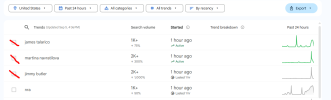
Example 1: None of the above appealed to me and fall into the short term trending category.

Example 2: In this one, Unemployment is a pre-existing long term niche that comes and goes throughout the year and needs more research.

Example 3: This is another pre-existing long term that's spiking right now and could use more research.
Establish Trend-Investment Criteria
Define what “low risk” means before you start scouring trends.
Apply data filters to weed out fads and highlight rising stalwarts.
Before getting attached to a term, run these checks in parallel.
Rank your final pool by a composite score reflecting risk and opportunity.
Note: Assign each term a total out of 5. Shortlist the top 5–10 for deeper due diligence.
Key Points for Identifying Low-Risk Trends
Domain Parking
Park the domain with a premium parking service to earn pay-per-click commissions.
Deploy a one-page site promoting affiliate products or services relevant to the trend. You can use a FREE customizable NamePros Landing Page for this.
Build an “early access” or “coming soon” page to collect leads and sell sponsorships.
Leverage the rising demand by listing the domain for sale or auction immediately.
Remember, at the end of the day, a domain name is truly only worth what a buyer and seller agree on.
What works for one may not work for another and vice versa.
Have a great domain investing adventure!
Today, I want to dig into how one can accomplish a longer ride for maximum value potential, rather than following others lead that have already been riding the wave a while and getting on your surf board a bit late, just before the wave breaks and missing out. Essentially, leading to holding the bag of domains in niches that just lost interest, Instead of gaining interest).
Every trend has a limited window of opportunity. Some may only last a few hours as news story breaks and other could potentially last years. It can be hard to detect which one will be true for the trend you decide to hop on a surf board for.
With the above in mind, let's dive right in...
Let's focus on using Google Trends for this exercise, since it's a viable resource.
Catching a Trend Before The Wave Forms
To do this, we have to start off by clicking the "Trending Now" option. Then sort by "Recency". My Geo selection is going to be "United States" for this exercise, but you can set it to any country you want to in order to capitalize on your local search niche trends that are just getting started.Trending now: Fast-paced spikes
Google Trends "Trending now" section, updated every 10 minutes, shows search queries that are experiencing a recent and rapid surge. The duration of these quick trends depends on the underlying event:
- A few hours to a couple of days: For news events, celebrity gossip, or other breaking stories that capture public attention quickly and intensely.
- Up to a week: Filters in the "Trending now" section allow you to see what has been spiking over the past 4, 24, 48 hours, and 7 days.
The longevity of a Google Trend is not predetermined. It is influenced by the nature of the topic itself.
- Short-lived fads: Highly specific or novelty topics can trend quickly and disappear just as fast, sometimes in a matter of weeks. Social media platforms like TikTok often accelerate these "microtrends".
- Long-term interest: Broad, evergreen topics, like seasonal products or major industries, may not cause a sudden "breakout" but can sustain or gradually increase interest over years.
- Cyclical trends: Some topics, particularly in fashion and pop culture, experience a rise and fall but return to popularity decades later.
Key Signals of Short-Lived Trends
- Sharp Single Peak
- A dramatic spike in interest followed by a steep drop within weeks.
- Low Baseline Interest
- Searches hover near zero except during that one spike.
- High Spike-to-Baseline Ratio
- Ratios above 10× often signal a fad rather than steady demand.
- Brief Media Buzz
- Correlate search peaks with one-off news events or viral moments.
- Minimal Geographic Spread
- Interest confined to one region or demographic and not expanding broadly.
Short-lived search terms peak sharply around one-off events or viral moments, then rapidly decline. These categories capture momentary spikes driven by entertainment, sports, product drops, social media stunts, or conference buzz. Recognizing these helps avoid chasing fads with no staying power.
- Entertainment Events
- Awards shows, film premieres, and TV season drops (e.g., “Oscars 2025 red carpet dress highlights,” “Squid Game Season 2 release date”).
- Sports Events
- Major match scores and replay searches tied to specific games (e.g., “World Cup final score updates,” “Wimbledon 2025 women’s final replay”).
- Product Launches & Releases
- Live streams and launch-day hype around new gadgets (e.g., “iPhone 17 Live Stream Launch”).
- Viral Moments & Challenges
- One-off stunts or social-media crazes (e.g., “Remote control F-150 Cybertruck stunt,” “New viral TikTok dance challenge 2025”).
- Conferences & Recaps
- Event wrap-ups and recap searches from niche industry or SEO gatherings (e.g., “Gavoyannis SEO conference 2025 recap”).
Key Signals of Long-Term Trends
- Sustained Plateau
- After initial growth, interest levels off at a higher baseline.
- Gradual, Consistent Growth
- Day-over-day and month-over-month increases of 5–15% without sudden crashes.
- Seasonal Recurrence
- Predictable annual or quarterly bumps (e.g., “tax filing help”).
- Wide Geographic Adoption
- Searches rising across multiple countries and languages.
- Cross-Channel Validation
- Reflected in steady news coverage, scholarly publications, or industry reports.
Search terms tied to sustained interests exhibit steady growth or plateau at a high baseline. These categories reflect ongoing consumer needs in health, finance, education, tech, and sustainability, topics that maintain relevance for months or years.
- Health & Wellness
- Diet guides, fitness routines, and meditation tools.
- Finance & Regulation Trends
- Economic outlook, mortgage tracking, and policy overviews.
- Consumer Tech & Productivity
- Device comparisons and remote-work setups.
- Education & Skill Development
- Online learning platforms and course reviews.
- Sustainability & Lifestyle
- Eco-friendly brand lists and long-term lifestyle shifts.
Sorting the Results to Create a Short-List
Example 1: None of the above appealed to me and fall into the short term trending category.
Example 2: In this one, Unemployment is a pre-existing long term niche that comes and goes throughout the year and needs more research.
Example 3: This is another pre-existing long term that's spiking right now and could use more research.
Establish Trend-Investment Criteria
Define what “low risk” means before you start scouring trends.
- Relevance to enduring markets (e.g., health, finance, remote work)
- Minimum baseline search interest (e.g., index ≥ 20 on Google Trends)
- Trademark and brand-safety clearance
- Budgeted spend per registration to cap downside
Apply data filters to weed out fads and highlight rising stalwarts.
- Growth Curve Shape
- Favor S-curve or plateauing growth over sharp single-day peaks
- Baseline vs. Peak Ratio
- Exclude terms with >10× spike-to-baseline ratios
- Geographic Spread
- Require upward trends in at least three major markets
Before getting attached to a term, run these checks in parallel.
- Domain Availability Scan
- Use bulk TLD search (e.g., Namecheap’s Beast Mode) to find unregistered variants
- Trademark & Regulatory Check
- Search USPTO or TMview for existing marks
- Linguistic Review
- Ensure no unintended meanings in key markets
Rank your final pool by a composite score reflecting risk and opportunity.
| Factor | Weight | Scoring Guide |
|---|---|---|
| Sustained Search Growth | 30% | 1–5 scale based on 3 to 7-Day trend analysis |
| Baseline Interest Level | 20% | 1–5 scale (higher is better) |
| Domain Availability | 20% | 1–5 scale (more TLDs open = higher score) |
| Geographic & Demographic | 15% | 1–5 scale across regions and audience segments |
| Trademark & Brand Safety | 15% | 1–5 scale (no conflicts = top marks) |
Note: Assign each term a total out of 5. Shortlist the top 5–10 for deeper due diligence.
Key Points for Identifying Low-Risk Trends
- Trajectory Shape
- True low-risk trends exhibit gradual, sustained growth or reach a stable plateau.
- Baseline Resilience
- A healthy base level of search interest outside major events reduces downside.
- Broad Adoption
- Cross-regional and cross-demographic uptake signals mass-market potential.
- Semantic Durability
- Concepts tied to ongoing needs (e.g., “plant-based diet”) vs. fad products.
- Institutional Validation
- Backing by media outlets, VC funding announcements, or patent filings.
Fastest Ways to Monetize a Domain for Emerging Trends
To capture revenue from a rising trend before it peaks, focus on minimal setup and immediate channels. Each of these five methods can be live in hours or days, turning your domain into a cash‐flow asset while interest is still climbing.Domain Parking
Park the domain with a premium parking service to earn pay-per-click commissions.
- Sign up with networks like Sedo, ParkingCrew or Bodis.
- Optimize your parking page for high-CPC ad categories tied to the trend.
- Monitor click-through rates and swap out ad categories as search intent evolves.
Deploy a one-page site promoting affiliate products or services relevant to the trend. You can use a FREE customizable NamePros Landing Page for this.
- Pick top-performing affiliate offers with strong commissions and tracking.
- Use a landing-page builder (e.g., NamePros Landers) for lightning-fast deployment.
- Drive organic traffic via the trend keyword and sprinkle in “how-to” content for SEO.
Build an “early access” or “coming soon” page to collect leads and sell sponsorships.
- Embed a simple signup form (Mailchimp, ConvertKit) for updates or pre-orders.
- Package sponsorship spots above or below the form to brand partners.
- Offer sponsors a share of the email list or exclusive access once the trend peaks.
Leverage the rising demand by listing the domain for sale or auction immediately.
- List on NamePros, Sedo, Afternic or Flippa with a “Buy Now” price pegged to your upside.
- Highlight trend-related keywords in the title and description.
- Use buy-it-now promotions or time-limited auctions to create urgency.
Remember, at the end of the day, a domain name is truly only worth what a buyer and seller agree on.
What works for one may not work for another and vice versa.
Have a great domain investing adventure!